Posts Tagged ‘YouVersion’

PearlVault and A Potential Solution to Notes and Electronic Bibles.

Monday, March 12th, 2012

Last week, we were contacted by Aaron Frey, who has begin a Kickstarter project called PearlVault asking to help get the word out about this project. We’ve not talked about some of the struggles with notes and electronic Bibles in a long time (something from 2008, and another something from 2006), and so getting this note about PearlVault reopens that conversation alongside the other collaborative features many have asked for in the Bible software domain.

About PearlVault
From the Kickstarter page:

…This project will create a web portal where you can take your Bible study notes so that they are searchable, taggable and indexed according to Bible references. It will also allow you to attach notes to words from a particular Bible translation–or even words from the original Greek or Hebrew. It will be optimized for the easy discovery of past notes whenever you study that same passage/word/topic again. It will also be optimized for use on mobile devices so that, even when you are away from your desktop, you are never away from your Bible notes. And PearlVault, should this project succeed, will be available for the rest of your life, independent of whatever study environment you use otherwise.

Essentially, your Bible reader of choice will utilize PearlVault as the syncing-linchpin for your notes content between Bible apps. Not a bad idea, and definitely down the road towards how we’ve supported similar-featured projects in the past in regards to being able to have more liberty with the content you create or own.

[Click here if unable to see the video embedded above]

The Challenge for PearlVault
The challenge for PearlVault is getting enough buy-in and interest from Bible publishers and software companies to support this effort. Hence, the Kickstarter project. Your notes would be stored outside of the application, so that in the case you’d decide to move to another Bible software suite, that you’d not lose the content you’ve already created. As it stands right now, of the Bible software programs which have a notes functionality, many times this is a feature within the application and you usually need an additional piece of software (or in some cases a full PC) to take the notes from the application and put it into a more generic format.

The other challenge actually comes from the users of Bible software. Much like with versions of the Bible, software can become an issue of comfort and attachment. And unless circumstances dictate otherwise, many people will stick with the same Bible software family for many years. Now, when they do change, there’s some general flow towards how they evolve with Bible software:

  • Many start with a free, gifted, or low-cost package; as they become more skilled in using the software, they may opt for the paid content or a paid Bible app with a similar user interface (UI);
  • Some start with a recommendation of personable apps such as Olive Tree, Pocket Bible, YouVersion, Logos, etc.; sometimes with the encouragement to try a few of these before settling on one; in the meantime, notes and other content is being generated that won’t transfer to the app they settle to
  • The last step forks one of two ways: either the person is such the student of the text (w/pastorial responsibility) that Logos and their deep library is the only option, or they are a mild-academic in terms of the text, looking to some of the lighter Logos packages, or the wares of Olive Tree, Accordance, or eSword (depending on content needs); the latter group is likely to use more than one Bible software package

Having said this, the challenge is actually quite apparent. Even if a person moves up and through several leagues of Bible software, they will have some (not major) difficulity in keeping their notes attached (programatically) to the text. Now, do know that we are talking about a specific set of Bible software users here, its not the normal course for non-pastor/teacher types to go through several iterations of software – folks just aren’t that patient. Those who are, and who have a genuine joy for searching the Scriptures so that this issue of notes between apps comes into play, just have different needs that’s not been met as of yet which PearlVault seeks to do.

More Information, Supporting PearlVault
PearlVault is using Kickstarter in order to raise the funds needed to support the building and maintaining of the service which will be hosting these linked notes. It is also in place to log the interest of people for such functionality. By placing your donation into the project, you help Frey’s discussion with Bible publishers and software developers who sometimes don’t want to look outside of their products, but do know that the user at times will.

Some additional information about PearVault and Aaron Frey’s motivations for the project have been detailed in an interview over at Christiandroid. Definitely check that out as it goes into a bit more than the Kickstarter page towards the project’s vision and aims.

And finally, support Aaron. Having been on the side of trying to just make Bibles available between platforms, I admire and affirm Aaron Frey’s project and what it aims to do for everyone who gets value out of storing, rereading, and sharing Biblical notes.


Mobile Ministry Forum Consultation 2011 Sketchnote

Thursday, December 29th, 2011

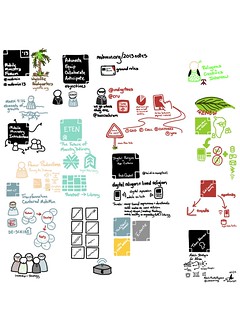
The 2011 Mobile Minsitry Forum Consultation occurred a few weeks ago and was certainly chock full of presentations, connections, and insights. Per our usual fare, there’s a sketchnote containing all of the moments we attended during the 2.5 days. Check it out, and look forward to detailed stories about some of the ministries and their efforts in future articles.

Got comments? Let’s hear them here and on Twitter (@mobileminmag).


Looking at the Perspective Amazon’s Kindle Gives

Thursday, October 6th, 2011

When I am at a coffeeshop, I usually have my mobile to the side of me and my iPad in front of me -occasionally with my wireless keyboard. At times, at least when I’m typing on the keyboard, I’m stopped to ask if I like my iPad, or how I get along with the keyboard. On one particular day, a woman asked me my opinions on the iPad as she was considering one. It just so happened that less than an hour before she asked me that, Amazon announced its new slate of Kindle reading devices (Kindle, Kindle Touch, Kindle Touch 3G, and the (color/Android) Kindle Fire). I mentioned to her that she might want to consider the Kindle – and it was apparent that she had. And then showed her the image seen on this post – her expression and the conversation that ensued afterwards got me thinking about how leaders, technologists, and then everyone else tends to consider technologies like what is exposed with Amazon Kindle.

For instance, the woman asked me what it is that I do with my iPad (reading, drawing, then everything else was my response). I showed her my artwork, and then the notes that I’d written at a recent church visit. The notes impressed not just because they were handwritten, but because she could see the point in not just having an electronic bible, but an ability to write notes, highlight, and then have those available on any computing device she owned. It sounds almost normal to many of us, but the perception that you can disconnect content from the devices you read it on is still a new idea to many.

She asked about saving the data on my iPad and how much space it takes. I explained to her how I don’t save a lot on the device itself as I use the entire Internet as my hard drive. We talked about how Amazon, Dropbox, Microsoft, and others essnentially give you their servers to use as the hard drive. In that case, its not always a limitation of the space that you worry about, but how you are able to control access, security, and what you are comfortable with storing on another company’s hard drives (servers). She noticed that on the pages for the new Kindles that there was no mention of the size of the internal storage and asked why that could be. I told her how Amazon is positioning their servers to be your hard drive – essentially making the Internet your hard drive. Her expression again amazed at not considering before that you could take what seems to be a normal computer function and turn it on its head.

So what becomes of how we talk and demonstrate Biblical texts? Could we have moments where instead of simply telling people to turn to such and such a passage that we could have shared that bookmark via YouVersion or another Biblical service. Or, maybe as a minister who is an aspiring author, do we learn and utilize services like Amazon Kindle Direct Publishing and Lulu to disseminate our locally-created materials instead of or in addition to the traditional publisher route? Obciously, there isn’t a need to do these kinds of things all the time, but devices like the Kindle will mean that we do have to consider that our use of the technologies available will endorse the purcahsees that many are already making.

Or, we can choose to not see efforts like the Kindle as being useful or beneficial for our respective audiences. Which is ok. But, if you are in the business of content creation or teaching, what kind of perspective will that lend to those whom you say you lead?

~ picture via Gizmodo


After You’ve Gained the Knowledge, Then You…

Monday, July 25th, 2011

Image: Dual pane view of Bible+ showing KJV and ESVA recent tweet by the Folks at Audio Bible/Faith Comes by Hearing (@audiobible) got me thinking (again):

If u could carry the Bible around with u in more than 500 languages – like in your pocket – how would u use it? #Hmmmm #GreatCommission

Original tweet.

I used to carry 1, then 2, then 15, and at one time over 100 Bibles around with me on my mobile devices (thanks Bible+). At the time, I justified it because I was (a) reading/studying Scripture a ton more than I do now, and (b) I interacted with several people who “heard” the Scriptures best in the translation they most used. Being that I was also at college during this time, it felt like the right way to approach speaking spiritual matters in a clear and consistent manner (1 Cor 14:1-19).

I don’t carry as many Bibles with me these days. In fact, until recently I didn’t carry any versions on my mobile (still no app, but I’ve got a Bible), and the ones on my iPad are the same in each Bible app or website (ESV, KJV, NET, and a few others). I’ve got less a need to carry as many versions of the Word as I do the onus to live as much of the Word so that when asked, I can give the appropriate answer to my faith (1 Peter 3:15-16). That, and the consistency of being in or near connected spaces allows me to search quickly from a series of websites when needed, or just make a note for something to come back later to.

That’s not the case for all folks. Many of the frequent travelers and missionaries I’ve met would jump at the ability to have Bibles and other texts in as many languages as needed, and at a moment’s notice. Their interactions almost require it of them. And when they are able to have something that speaks right to their audiences, it makes living among mixed groups that much easier to manage. When they don’t have that content, or even the ability to get a clear translation, their relationships to people and environments suffer.

But such use speaks to that end of things – where the tweet asked “how would you use it?” Many of use have libraries of Bibles and other content in print on bookshelves (digital and otherwise), but what have we done with it besides making it decorative? Have we taught someone to read, or took the time to use those resources to tutor people who are studying those subjects we’ve collected? Have we engaged the cultures beyond the pages and held the kinds of conversations that would amplify or change our opinions of those cultures, people, and events? Or, is it just a number?

In grade school, many of us learned about the terms kinetic and potential energy. Kinetic energy is identified by its impetus to move – the energy immediately before movement happens. Potential energy, on the other hand, is energy that is stored and is usually static due to its position or configuration. You’ve got that neat Olive Tree, Logos, YouVersion, or Bible.is app with hundreds of Bibles and other materials ready to be used. Are you in the process of transferring that energy into the lives of others, or are you configured simply to display the potential of what can be?


A Healthy Dose of Rambling

Friday, June 3rd, 2011

N8 and Ice Cream - Share on OviHaving been on the road for the better part of the past seven days, the news queue here has been a bit on the shrinking side. We’ve been keeping things going on Twitter (@mobileminmag) and engaging in some smaller conversatoins there. Here’s our attempt to get you caught up with where MMM.

Apps and Challenges

For example, in one aspect of the past week’s trips, Brett (one of the contributors here) and I got a chance to connect and talk about how we’d like learn better cross-platform development techniques for some of the content that we own or read. We got into talking a bit not just about apps, but things like QML, HTML5, and even the mobile web server. Being on an edge of mobile use, we’re finding that its not just a matter of having access, but there’s sometimes when ownership and accountability needs to also be a part of the pie.

That goes into the Kiosk Evangelism project that MMM has been a part of and some of the challenges there. As a project, its going through a leadership transition. Some of the questions though influence practices and understandings. For example, if creating a mobile-tuned service (such as the digital library component of Kiosk Evangelism), does it make sense to go native with an app, or use the browser and possibly something like Modernizr to create a UI that plugs into several systems an scales well. Does such a UI need to also be offline-context-sensitive, and if so how?

There’s also the challenge of owner rights. Church Mag recently opined about jail breaking and it caused me to go back into the archives a bit and relook at just how free we are to customize devices or interfaces. Certainly, there’s a challenge all around if you want to do something right.

Some are better than others with challenges. I’m always impressed at the energy and execution behind Logos and YouVersion and their latest projects serve as a solid measure of encouragement. Of the many support and feature updates for the application and service, I’m impressed the most with how YouVersion is paying attention to how we hear the Word. Audio and native language features ring most relevant for a lot of folks. Logos has released Vyrso which is basically a reader that goes beyond just Bibles. Through that system, I wonder how many budding authors will take up the challenge towards creating content that empowers and reveals the impact of the Gospel? Seems like as good a channel as any to do so.

Events and Movements

On the other side of happenings, there are several events and movements happening that all have something to do with how we approach (or at least view from our perspectives) mobile ministry.

The Uplinq Conference recently concluded. We attended this last year and had a great time as a part of the WIPJam Panel talking about opportunities and challenges for mobile developers. This year, the conversations started on mobile and there was a lot of innovations presented in mobile and blended reality computing.

Due to scheduling, we cannot attend this year’s Muther Hackathon, but we certainly want you (or your dev team) to get out there to it. If you would like passes, shoot us a message or tweet as we have a few free ones to give away.

MMM will be at the ICCM conference in Indiana in a few weeks. We’ll be speaking on a session about mobile ministry, actually breaking down that sketchnote that we’d posted here last week. We’d love to connect with you if you are going to be there.

And don’t forget about the Carnival of the Mobilists. Though its now on a once-per-month posting queue, the selection of articles that makes it to each Carnival seems to get better and better. This month No. 249 is being hosted over at Francisco Kattan’s site. Now that I’m not in my car or in front of folks for a few hours, its definitely something that will enter my rested reading time.

MMM Team and Role

Personally, I’m having fun with a new mobile (the Nokia N8) and some of the challenges around using it with my personal approach to mobile. That part has been fun, but its also led to finding some nuggets that would be valuable here.

Our team has taken some heavy shots personally and spiritually lately. Its been an honor to keep them lifted in prayer, but having been sick last week definitely showed me just how fragile all of us can be.

What is MMM’s role? We point to what’s happening. Unfortunately, we’re also finding that people sometimes need help with finishing what they started or just telling their message in a manner that’s able to be heard. To some extent, we are a media initiative, and to another, we’re just some hands and feet to some parts of the Body that want to move forward with a pure and honest depiction of the Gospel in their contexts.

That makes for a wide and deep role for us. And honestly, one that a single person has trouble with, let alone a small team. If you’ve been interested in getting involved with helping us share the stories of faith and technology, get in contact with us. If your heart is in other areas, and you’d just like to know how we can be supported, get in contact with us.

We’ve got some house-cleaning to do on some of the pages here we know – and we’ll get to those items in time. In the meantime, there’s a Body using this tech that’s asking for the road that isn’t techie or overly theological. We’re helping to cut a trail, rambling on about what we find as we do ;)


Addition of Ink Makes Tablet a Better Bible?

Wednesday, May 25th, 2011

HTC Flyer screenshot of Bible app with ink, via Mobile GadgeteerThis past weekend, Matt Miller opined that the new HTC Flyer Tablet might make for the right approach to being a digital bible replacement because of it’s inking ability. During this specific look at the HTC Flyer, Matt notes just how well the ability to ink on the screen adds to the experience that many Bible reading applications already offer.

Spending much of my reading time on a tablet, I can relate to how well this can work within many application environments and communities. And as Matt also shows, using a service like Evernote along with is could also pull some of those behaviors that some are used to (writing in margins, etc.) into a digital domain to take advantage of some of the capabilities that paper just wouldn’t have.

This is a use case more centric to tablet (and even laptop) use. And so we should be careful not extrapolating it to every mobile device that can handle ink. Inking, specifically as we are looking at it here, takes advantage of the larger screen spaces tablets offer, and could also blend some spatial interfaces not used as well on small mobiles.

If inking could work, what are some ways that you could see the exploration of Scripture draw someone into a better understanding of it, or even help a small community better understand how to study the bible together (a community sketchnote if you will)?


Where is the Christian?

Sunday, May 22nd, 2011

Wine Country - Share on OviIt’s Sunday. Where is the world? where is the Christian?

I had to think about this for a bit, but history agrees with me: media has contributied to (and oftentimes accelerated) the disembodiment of those things we consider “spiritual” and those things we consider “life.”

We look at the term Christian and some see it as a form of language, style of dress, political views, or even just the signifiers of people based on a common location and behaviors on a few days a week. Some see it as all of the above. When the phrase Christian was termed, its was first a slander for a sect within Judiasm who happended to also be persecuted physically, economicaly, and socially. Peter took this title and used it as a point of empowerment (1 Peter 4:16).

From then on, it would seem that the early church saw it as connection – a unity defined by love for one another, demonstrated as love for their world that effectively preached the hope of reconciled unity with God. Location was only part of it. Behaviors were a contentious part of it. They maintained an identity not because of location or behaviors though, they thrived because they werent limited by either. There were various contact points, the Scriptures, letters from disciples and other community/church leaders, meetings places, and events. These were Christians, ever being pushed, pursued, and transformed. Constantly finding their place within layers of life, defining themselves by a layer of a life that reaches beyond.

Last week’s article from CNN throws some fuel onto the discussion. The author postulates that while remembering the democracy and effective changing of the world by the printing of the King James Bible is good, we should also be calling to question whether we have been as present with the faith (as a Body) as the technology has allowed us to be. To borrow from several streams of discussion over the past weeks: are we Christians because of what we do, or because of whom we are connected to?

A person noted on Twitter (and several retweeted) that they disagree with the title and conclusion of that CNN piece. I can see how they might disagree with the title, it takes a strong and pecular-to-the-age kind of faith to agree with the point that a technology is stripping the leaves off of what we might have defined as Christian for several generations. However, the fact of the matter is that efforts like YouVersionBeRemedyJesus.net, the Lausanne Global Conversatioins sites, and thousands of others are making the concluding statement of that article a point that has to be understood as an implication to those efforts:

…When Bible study can be done on Facebook as easily as in the church basement, and a favorite preacher can teach lessons via podcast, the necessity of physically gathering each week in the same place with the same people turns remote. Without a doubt, this represents a new crisis for organized religion, a challenge to think again about what it means to be a “body” of believers.

You cannot give people personal access to the Bible (or any tome of knowledge) without it later redefining their relationship to it and to others. If we do not understand this, but hold onto models of Christianity which are imperial/behavioral, then we are the worst hypocrites – plunging digital behaviors into a box they don’t fit, constraining a faith that was never meant to fit in a box (Exodus 20, John 4:21-24).

Lives that are unified (John 17:20-26) and knit by love (Deut. 6:4-8) and identified by love for one another (John 13:34-35) preach the Gospel. The CNN article says as much in that conclusion, as we should all be saying with our endeavors in this digital faith space.

So then, where is the Body? Is it cloistered on this mountain or that mountain (John 4:19-24)? Or, is it knowable by a select few (Mark 6:1-3) and therefore found only in specific social contexts? Or, is it identified only by a certain association (Mark 9:38-40) that’s unable to be recognized unless it runs with the clique? Or, is it Body that speaks to the one who saves (John 17:1-10) that connects where-ever, influencing a world how-ever, espousing the same message (1 John 4:2) no matter the context?

To the discussion that the CNN piece raises, we’ve got to let go of elements of what we’ve used to define Christian in the past. They were layers then, and hindrances now. The technologies of our time can help push those things away, but we shouldn’t let those contact points define who or where Christians are. A life that connects, lives by love defines the Christian. Were in print and digital faith are those contact points?


Retweets of the Week (Jan 30 – Feb 5)

Sunday, February 6th, 2011

Once again our Retweets of the Week feature highlighting some of the items we’ve retweeted in the past week.

If you’ve got something you deem worth sharing, be sure to point it out to us (@mobileminmag) or use the #mobminhashtag if its directly related to mobile ministry efforts.