Posts Tagged ‘mobile in media’

What If Reading the Bible on My Mobile Was Like Stepping Into the Middle of a Video

Thursday, May 24th, 2012

Mobile phone in hand with green screen
I have had this article about embodied cognition from Contents Magazine sitting in a tab or Evernote for the better part of two weeks. Each time I glance and reflect on it, I am left asking the question “why is the Bible I read on my digital devices so flat?” I have my own project (All Books) that in some ways seems to be addressing a temporal association to the text, but really, much of what we interact with in the Bible isn’t text, it’s emotion, space, activity. 

There is a sense to find your imagination around you while reading the Scriptures, but very little that you can do until you read all of the associated historical, sociological, and theological commentary around it. In a real sense, you have to create the world around which you can view Scripture within its lens (that is, if you are event interested in hearing it in the voice that it was written in). But, isn’t that kind of looking at things the wrong way – fitting that world into your own? What if the engaging of a Bible on a digital device (a digital window if you will) were more like stepping in on a conversation happening, and your digital window wasn’t text at all, but a series of still and moving images, mono and stereo audio – where you were always coming into the middle of a moment, no merely being in the seat of the narrator?

I am thinking almost in the sense that each of characters or books in the Bible are a channel. Each of these channels plays content that maps directly to the written text, but loops mich like an audio playlist. You only get to choose the character or book though. As soon as you make that selection, you are locked into wherever that story is happening right at that moment. This would be something like the Bible Experience audio series, but instead of simply walking into something narrated, you would literally be coming into still images or a performed program.

If you will, recapturing some of the creative energies that are used to display and tell the events of Scripture in layers, leaving the text as perhaps a caption or linked reference (similar to the Info/Guide button on a cable TV station). Again looking at engaging the text not from the perspective of studying, but more from the attitude of tuning into see what this channel of life is up to.

I know, it sounds like basically taking TV/YouTube as just running it all the time. But, I am asking for a bit more. Where the viewer doesn’t have control of where they come into the scene. Where there is no rewind. What if when you took your mobile, while reading in your favorite bible app, from the position of having your head down, to picking your head and mobile up (similar to holding it for taking a picture) and then Scritpture that you were just reading started to play like a movie in front of you. That’s what I am thinking here.


You can Log Off But Not Opt Out

Monday, May 21st, 2012

A few weeks ago I came across this article, Social Media: You Can Log Off But You Can’t Opt Out, which has put forth some interesting viewpoints, and to a large degree puts the right perspective on social media tech and the constraints they impose socially. Here’s a snippet:

…So technology is political in the sense that it is a site of struggle (perhaps, one could say, communication technologies are “places where revolutionaries go“) but it is not political in the naive sense that it determines the outcomes of social action (i.e., there are no Facebook or Twitter revolutions). Most relevant for the present conversation is this concept of non-optionality—that we can neither opt-in or opt-out of the socio-technical system. We are all touched by the emergence of new technology, even those who are most marginalized within the system. Because, at any given historical moment, technology and social organization are always linked, we all inevitably feel the ripple effects when new technologies are introduced. This very point was the premise of the South African slapstick film The Gods Must Be Crazy, where a single Coke bottle tossed from a plane is imagined to upset the entire social order of a remote Bushmen tribe (caveat emptor: racist and inaccurate portrayals abound)…

Read the rest of Social Media: You Can Log Off But You Can’t Opt Out at The Society Pages

So, going back to a question we posed a few times already, if you are gong to tell people to use mobile or social networking (an app, for announcements/broadcasts, etc.), are you going to spend the same energies talking to the, about it’s downsides?


Trying Out the biNu Mobile App Developer Platform

Friday, May 11th, 2012

Per our usual activities here, we occasionally check out processes and software which would be relevant to the #mobmin (mobile ministry) world. A question for many groups is the process of making a mobile application, and so we definitely like to take a look at the various application creation platforms that are out there to get an idea of what’s needed in terms of graphical, technological, and marketing knowledge to get things up and running. The latest of these development platforms we are looking at is the biNu platform.

biNu is a software delivery platform. Think, something like an app store – but optimized for feature phones (non-smartphones). When there is an opportunity for an engagement to be accented with a mobile app on a (most likely) Java-based mobile, biNu is positioned through its delivery platform to refactor your RSS feeds or any other custom (mobile-lite) page content into a downloadable application for these mobiles.

We took a look at it from the perspective of  a content owner who’s looking to gain a presence on feature phones (its a good idea to read Should Our Church Have an App or Mobile Website prior to this). Therefore, our most important places of entry happen through the biNu Dev portal (still in beta – this comes up again).

Note: the screenshots and activity here were performed on a Windows 7 laptop using the Google Chrome browser. For the benefit of the impression, this is an imposed boundary to using the product.

Step 1: Registering for at the biNU Developer Portal

As with similar services, you have to go through a short process to register for the biNU developer portal (http://developer.binu.com/). After filling out the form, you get a confirmation screen noting that you need to complete a step in your email in order to complete the process. Nice and simple in this respect.

Step 2: Navigating

biNU Developer Dashboard

Once you login, you are presented a straight-forward list of what you’d want to do: List Apps (see all the apps you’ve built), or create a new Basic or regular app. First up on my listing was to do the Basic App (this would most likely be the used option for 1st time users of this service).

Step 3: The Basic App Wizard

biNU App Wizard

Once you get into the Basic App creation wizard, you simply just add the title and description to your app. You do need three graphic files here. Though the sizes were specified, I noticed in the test view that all of them seemed to be resized fine. I’d recommend here not using anything smaller than the recommendation, and you will need to ensure that its a PNG graphic w/o transparency for best effect.

You will also need the URL for the RSS feeds that you would use to populate the app. I took our raw feed, in addition to our Twitter feed and the Twitter feed for the #mobmin hashtag (we’ve done this previously with other apps) and there seemed to be no issue with either of those kinds of sources.

Step 4: Testing/Further Edits

biNu testing emulator

biNu offers a Java-based emulator that gives you an impression of how your content will flow to the smaller screen and different input controls of a feature phone. On the PC that I used, I didn’t update the Java client in order for this to work properly (but you would probably want to do this).

Step 5: Publishing

biNU Publishing Your App

Once you have created and tested your app in the emulator, next is to publish it. There are two avenues for publishing – the first puts the app on the biNu platform “store” where those who’ve downloaded biNu would be able to search and download it among other similar apps/services. The second avenue is for you to generate the app yourself using biNU, and then use publish that app on your website or wider-serving app stores such as GetJar.

biNU Generate Java/Android app

When you choose the option to generate an app, you are taken to a screen that’s similar to the app wizard where you refine the details about your app. What’s most interesting here is that you see the option to generate either a “regular” Java app (ideally, compatible with most Java mobiles) or an Android java app (an apk, compatible with Android devices). Apps can be unsigned or signed using Verisign or Thawte. Again, good options for an app which could be distributed in an open market environment.

Generating the app was the only point in the process where I entered an issue that I had to escalate to biNu directly. As of this writing, this is something being looked at.

Step 6: All Done, Go Build Some More
biNU listed apps dashboard

Once you’ve finished making your app (testing, publishing, and generating Java versions), you are pretty much done. As seen in the publishing step, you’ve been given a URL with which to publicize the app (I’d recommend using a URL shortening service like TinyURL or Bit.ly to make it smaller, more share-friendly, and easier to add to marketing materials). View/Download the 1st MMM biNu app.

Conclusions:

Overall, using the biNu app wizard enabled me to build an app in less than 30min. When I went back through the process to build an app from scratch (see Step 2: Navigating), the process took even less time because the source for the app was an existing mobile website (in this case, our alternate mobile site which is written using HTML5 and jQuery). Given the speed and costs (free) to just get on their platform, this isn’t a bad idea for many sites. I’d like to know how some of the more interactive content offerings would fare here – for example, those doing church online might want this for a presence, but the experience of viewing media on a 2.2in screen that’s not optimized for such “snack time” viewing might be a turn off in some respects. Still, there’s some sense that could be made from doing this and perhaps pointing to your YouTube feed of content.

For more information about biNU, do check out their website. Again, the developer section of the site is in beta right now, so if you enter into any issues with it, do chalk it up to that aspect of things. Still, there aren’t too many mobile services specifically targeting feature phones (more people use these than smartphones by a very wide margin). If your content is ready to go, then biNu should be ready for you.


One Year Ago: Sketching at the 2011 GCIA Conference

Wednesday, May 9th, 2012

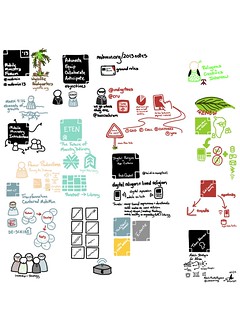
GCIA SKETCHNOTELooking back over the past years, I came across this posting and sketchnote from the 2011 GCIA Conference. There really was a lot of information passed during that time – much, much more than could be gathered by one person or a drawing. But, I can see in that drawing some of the things I thought about throughout. Of some of those points that I can remember clearly in seeing this again:

  • There was a urgency to not miss the boat any more than sensed when it came to digital ministry efforts
  • There was an openness to conversing across denominational and organizational lines
  • While it was opined, there was little anyone could really solve in that space towards non-English content (almost like English stunted the activity we could do outside that context)
  • Folks loved their mobile apps
  • Creativity is seen as a smaller activity than production (organizationally)
  • Mobile can be understood by talking, but better known by living

Just things that came to mind. I enjoyed that time, and perhaps will get to connect with those from that GCIA meeting in a conference this year.


Upcoming Conferences: Biola Digital Ministry, ICCM, and More

Tuesday, May 8th, 2012

If you’ve been paying attention to the wealth of events noted on the #mobmin (mobile ministry) calendar, you’d know that its been a pretty rocking time in terms of conferences as the spring as worn on. With summer meetings just around the corner, we wanted to let you know of two upcoming conferences we’ll be attending – with the hope that you’ll come out to one or both and join for conversation, networking, and knowledge sharing.

Biola Digital Ministry Conference (June 5-7)

The Biola Digital Ministry Conference is designed to empower individuals with the vision, knowledge, and relationships necessary to be thoughtful designers, developers, and practitioners of digital technologies for the cause of Christ.

This conference features 14 speakers, a Digital Ministry Hack-a-thon, and sessions grouped around technology and practical applications. Besides the weather, I’d recommend attending this conference if you are looking to hear not just what’s happening in the digital ministry space, but also how to position you/your ministry/your organizations for future trends and disruptions. There’s the Biola Digital Blog featuring some of this year’s speakers to give you a taste of what to expect in this year’s conference.

For more information and to register, visit the Biola Digital Ministry Conference website.

International Conference on Computing and Mission – aka ICCM (July 16-20)

The International Conference on Computing and Mission (ICCM) is an annual informal (NO ties allowed) gathering of women and men who have a common interest in computers and mission. We share a vision of cooperation for effective use of technology, bringing the Gospel to every nation.

If there was a geek fest specifically for ministry, ICCM would totally fit as a great sounding call. Feeling one part like an IT retreat and another like an IT refresh station, ICCM is very unique from other conference formats in that it (a) happens over the course of the middle of the week, (b) emphasizes spiritual fellowship and accountability as much as IT and (c) offers a unique opportunity to hear from those persons working in ministry support areas as easily as you hear from those who do more strategy-focused activities. Moving to Colorado Springs, CO this year (from its usual location at Taylor University in Indiana), there seems to be a neat energy about the connections and sessions happening.

From poke that I got via Twitter yesterday, there may still be some time to take advantage of early-bird registration. For more information, including learning more about the other ICCM events happening (Europe and Australia), visit the ICCM website.

Other Events this Month to Take Note Of:

  • CTIA (mid-week conference sponsored largely by mobile ) began today; news and press releases will be trickling out throughout the day (check out relevant highlights using Twitter and the #ctia, #ctia12, and #mobmin hashtags)
  • The Christian Media Conference starts tomorrow (5/9) in Australia (Gold Coast)
  • Mobilism starts 5/10 in Amsterdam
  • eLearning Africa and the Open Mobile Summit happen in the 2nd half of this month.

For more information about these and other events, add the #mobmin (mobile ministry) calendar to your bookmarks, favorites, or RSS reader.


Is Keeping Up All Your Community Amounts To?

Monday, April 30th, 2012

screenshot of Facebook friends page
Sunday mornings in the SE USA offer a distinct impression towards communities and what people value. For some people, the hours between 8AM and 1PM are spent in within their faith communities, singing hymns, listening to sermons, and reconnecting to people they may or may not see throughout the course of their week. For some, those hours are a recovery period from work, parties, or family engagements held throughout the week. And for some still, those hours are spent leading the charge for the new week – whether that’s working in retail, starting meeting, project, and lesson plans, or getting in that exercise regimen that can other times during the week be more elusive. Indeed, there’s a lot of life that happens in these hours, and within those contexts noted above, there’s a question that a few moments on a recent Sunday begged me to ask in light of what kinds of communities we’ve become.

Two contexts…

The first sees several of the local broadcast channels displaying current or replayed messages from local, regional, and national churches. Within one of these I stopped on, the encouragement from the pastor was to align the fact analogy of the resurrected Jesus walking with the two gentlemen on the road to Emmaus (Luke 24:13-35). Inside of the sermon, the pastor goes inside and outside of the margin of the text – beginning first with the aligning of the appearing of Jesus as a matter of comfort to the situation which was a matter of shock and anxiety for those who walked with Jesus and knew him. And then he ends towards another margin, speaking to the need of people to be connected to the community of believers whom are on the road of life as well, with a chance that at some point in the relationship they will meet Jesus. As this broadcast happened, there were several points where the camera panned to various persons in the congregation, as well as the on-screen notation of the name of the pastor and the church. No address, website, etc., just the pastor’s name and the church’s name. After the sermon ended, I continued to parouse other channels to see what else might be asking for attention.

The second was a few hours after the above sermon was broadcast, while setting myself to work on a few pieces for the site in a local Starbucks. As I entered, I overheard a group of people talking about the communities they grew up in. Seemingly excited to know that there was so many similar connections between them, one of the women mentioned someone in her circle that has some local nortoriety. At least from her tone, she was proud of the connect. Then male in that small group spoke up about him going to school with her. He remarked about going the entire gamut with the famous woman in the same classes, all the way through to the end of high school. Then he said, “these days I’m connected with her on Facebook. That’s how you keep connected to people you used to know. Well, I’m only as connected as seeing her updates. We don’t interact all that much.”

It was the latter context that led me to sit down and write this much. In the latter, we have a participatory medium – the Internet – and a common channel – Facebook – being used for communication between those people, organizations, and brands who wish to interface with one another. In the former story, we have the one-way medium – TV – and itself a common channel – the rhetoric of the sermon – being used to share a central message that’s designed to knit the listeners around that common experience of listening, and moreso around how they share in the interpretation and activity because of what they listened to. And yet, both of these medium choices (Internet and TV) bill themselves as creating a community, or at the very least enabling community-defining behaviors.

What are the communities that are intended to result from these media actions?

If I’m being critical of the TV message, I found it confusing to be getting a message about being connected to both faith and community, but nothing in the broadcast – at least while I was viewing it – left a bread-crumb trail as to how to do that to that specific community or another one. At least, not the bread-crumb that we are used to – there was a name of the pastor and name of the church – certainly the Yellow Pages would be sufficient for making the next steps.

But then, there’s the critism of of Facebook users I overheard. They already had their Yellow Pages, and indeed something more defined than a name and address, they had some cycle of activity so that they could see for themselves when and how best to build some kind of relationship with another. However, it was only being used as a signaling channel – connection only good enough to get reception of what’s going on in another’s life, but not to build into their lives or be built from their’s. Very much similar to listening to a TV message in application despite the Facebook’s ability to be more than simply receiving a broadcast message.

I wondered, is this the kind of community then that we create with social networks? Yes, I know that many of those visiting here are quite active on their social networks, mixing broadcast announcements with rebroadcasts of other’s brands/announcements, with conversations. But, we can’t assume that everyone who uses these social networking channels are doing the same behaviors. In fact, if one were to take our second story as the norm – following people to keep tabs, not to have a conversation – then we might want to make a better question about social media strategies and approaches that mark our use.

What is the community that you are building as a result of how you utilize one-way (broadcast, P2P) and participatory (Internet, social networking) media channels? Could the resulting behaviors you notice within those be influenced by something more than the content you are filling it with?