Welcome to the second issue of Mobile Ministry Magazine (MMM) simply titled Envisioning. There was a decent response from the year’s first issue and so we are going to continue down the same path with this package of observations and insights from the mobile ministry (#mobmin) space.
Its now a few days after Christmas, and you might have been blessed to receive a new device, a gift card to an app store or two, or just want to refresh your wares with something different. Here are some #mobmin-tuned recommendations:
I might just come back to this and add a few more items to it as the days continue. These were just a few of the items that have come up over the course of 2013 and been impressive in their respective contexts.
What would you recommend? Make a strong case and we’ll add it here.
Am still working through notes and such from the 2013 Mobile Ministry Forum Consultation, but while doing so, I wanted to jot down a few things which are still sticking out as points of reflection.
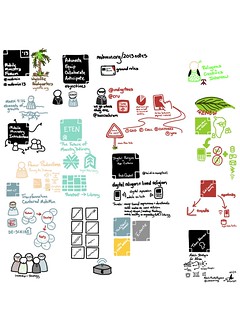
For those who usually follow me, you know that I draw my notes during conferences, workshops, and Bible studies. I did the same here. Here’s the PDF (because you’ll want to zoom in for the really, really small stuff) and here’s the JPG – posted on Twitter and Google+ if you want to share too
I actually was very surprised to see so much paper used during the conference. And then Clyde Taber pulled out using an Apple TV and his iPhone – from a happy-in-tech moment, that was one of the best (4 years ago, he gave me a blank look when I did stuff like that).
Pay attention to Heidi Campbell’s work – some good data backing observations said here and other places; her upcoming study on digital religious creatives will be great
Talked a bit about version 2 of the Mobile Ministry Methodology – even gave a preview of the analytic tool that will be launched alongside it. Guess who has more work to get done. See Version 1 of the Mobile Ministry Methodology
Distribution using SD Cards is all the rage. Lots of folks wanting pure voice solutions though.
The range of age was nice to see, and not like it was a few young and a lot of old; there was a lot of everyone (except women – conferences as a whole just need to be better on that end)
If you get to meet Kent Shaffer – just listen. The Spirit of God rests on him. He was live-blogging the conference too (Preview, Recap 1, Recap 2)
Each year, someone comes with a heavy bat of stats and info. This year it came twice: Faith Comes By Hearing and Tomi Ahonen – loved it
Best quotes: “Information is not transformation” (John Edmonston of Cybermissions) and “Recharging and Redemption” (Tomi Ahonen)
There were rumblings from some folks about how to pay more attention to the rise of the church in sub-Saharan Africa and SE Asia – I can imagine that next year, those folks will be represented well.
I didn’t have the best of attitudes at the beginning of the conference, just kind of didn’t feel like hearing the same things (its been a long time in this space); by the time it ended, I changed – and got some timely and appropriate honesty from a few folks. I’m grateful for those in the Body who still pull us aside and let us know about ourselves.
That’s all for now. I’ll figure out something else in terms of reflections on another time. Check out the #mobmin13 and #mobmin hashtags on Twitter and other social media spaces for reflections from others. Or, go out there and experiment a bit.
A number of persons have written in over the year asking about various aspects of the two mobile ministry courses that have been on deck. With the CLA course on pause , the MMF/Cybermissions Mobile Ministry Course has been able to target the #mobmin audience with a unique and decent offering. And as such, there are discussions and comments that come forth that don’t always make their way into press clippings. For example, the following case study was posted as a discussion response to the question:
Describe the advantages and disadvantages of these social media platforms (for Christian ministry) – in your particular area?
Here’s that answer, posted from one of our friends at a large media ministry:
I work at a global level so it is difficult to address this week’s discussion topic specification “in your particular area.” So I thought I would pick a particular part of the world where others in the course might think it would be challenging to use social media and share how it is being used effectively and discuss the advantages and disadvantages in this particular area.
Our Digital Strategies leader in Eastern and Southern Africa did not receive the memo that internet strategies and social media do not work effectively in Africa! He is building very effective strategies employing internet-based strategies, particularly social media-based strategies.
Facebook Jesus is the latest strategy and has been run effectively in Ethiopia and Rwanda and will soon be launched in South Africa. Facebook Jesus is an evangelistic strategy mobilizing students and young professionals in a one-week focused effort to influence their Facebook friends with the gospel. Using African communal cultural concepts, people gather in groups for several hours and work together to post videos, stories, poems, Bible verses, and other content on their Facebook pages and interact with their friends who show interest. They pray together for interested friends. They celebrate together for those who respond. They repeat this for several days.
An info graphic gives an overview of the week [click here]
32 people contacted 1006 friends with a total reach of 77,531 engaged users and a viral reach of 195,020 people. (Note: engaged users and viral reach are Facebook social media terms helping measure the impact of the campaign and are based on Likes and Comments.)
Since Ethiopians tend to be friends with Ethiopians, the impact of this week of social media outreach is staggering.
Miheret Tilahun, the Digital Strategies leader for Eastern & Southern Africa, has written and collected guest posts on how to run effectective Facebook Jesus evangelistic campaigns. He has not yet collected these into a specific category so you will have to browse through his website at http://miheret.wordpress.com/. His site is full of excellent tips on how to engage and mobilize people for a Facebook Jesus campaign, how to train online missionaries, what to put on your Facebook page, how to followup, and many other tips.
The Facebook Jesus strategy was taught as part of the recent Ubuntu National Student Conference in Durban, South Africa. You can watch this video of the excitement of some conferees, including a pastor invited as a conference speaker:
Discussion about internet ministry starts around the 3 minute mark in the video.
Here are some comments I transcribed from the video:
Social media is a new mission field
By being intentional and using the tools that exist on the internet, I can do much more [evangelism and discipleship] than I am doing currently.
Social media evangelism is something I hadn’t heard much about before. It’s a very unreached area. It’s something most believers are not aware of. It seems more effective.
I was affected by how much I use Facebook and even become an online missionary. It is something I had never thought about. I have a lot of friends on my Facebook page but I hadn’t seriously thought about ways to seriously impact them effectively.
Some advantages of Facebook include: Africans who use Facebook tend to be younger and rising leaders. They are willing to take risks and to try new strategies.
Disadvantages continue to be technological limitations.
There’s a lot to be explored and discovered as the mobile ministry field grows wider and deeper. Courses like the Mobile Ministry Course help individuals and organizations get there. Don’t look past what these can offer for you. And if you have something to contribute, come on in and do so.