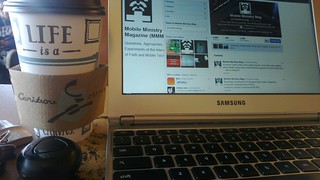
I’ve got a few pieces sitting in the tabs that I’ve wanted to expound on, but just haven’t made the time to do so. Here are some of those items sitting under that extended contemplation:
…One of the things I love most about technology is the space it allows us to dream and innovate. There’s always an opportunity for something new and people are hungry for it. So, if mobile technology has truly expanded to become a part of our daily life, how can we use this to reach people with the truth of Jesus Christ?
Read the rest of Mobile Technology and the Church at The Issachar Initiative
…Second, I’d like to point you to a great little book called Shaping a Digital World: Faith, Culture and Computer Technology by Derek Shuurman, a computer science professor at Redeemer University College in Canada…
Read the rest of TheoMedia and Other Great, New Books on Technology at Don’t Eat the Fruit
…Vision must be aligned to the company’s mission: What is great about the drones is that they actually make a lot of sense given Amazon’s core business model. As I wrote previously in Amazon’s Dominant Strategy…
Read the rest of Amazon and the Benefits of Vision at Stratechery
…this points to how important research triangulation is to make good decisions based on insights, not just data. Real insights are found at the intersection of different research methods. Not over in the corner with just one method…
Read the rest of Conversions Are Not People at Elezea
In the case of the touchscreen, the spatial and visual meaning is not exactly gone, but is now floating and inflated. The touchscreen has multiple screens—each screen, a unique landscape. The single smooth surface offers itself for multiple landscapes and constantly changing meanings. At one moment, a swipe will unlock the phone; the next, the same swipe will answer an incoming call. Same motion, same locations, different meanings. The touchscreen’s agnosticism permits multiplied meanings.
Read the rest of Unbuttoned: The Meaning of Buttons in a Touchscreen World at The Second Eclectic
…Digicel built its business model around going to small, difficult countries that larger companies would avoid. These countries are challenging environments that “you’d run a mile from” because they don’t seem to have the resources to afford mobile telephony, says Colm Delves, Digicel’s CEO…
These all might read like stars on a cloudy night. But, I’ve had them set because these all speak to various points about mobile ministry which might elevate opportunity, best practice, caution, or surprise. I don’t know what might consist of those items on your reading list, but these are just a few of mine. As you walk though the holiday – and a slower news cycle – perhaps part of what stays open in your tabs provokes your imagination or sense of opportunity.