Archive for November, 2011

Understanding and Differences Between Internet Ministry and Mobile Ministry

Wednesday, November 16th, 2011

Am writing this a few hours after listening to Dr. Markus Pfeffier from Regent University give a talk on the implications of the Internet and virtual environments. Much of this talk I’d already known, but both the speaker and audience were more unfamiliar (association and generational differences). As I listened, I wrote a bit of notes on items covered and not covered and realized by the end that much of what has been, and will happen, when mobile is added to the list for many of you, is that you will draw mobile into the same body of work as you do Internet ministry activities. There is some overlap, but not quite the same.

Let me summarize by restating the tweets (@mobileminmag) that relate to this point published before the writing of this piece:

This morning, listened to chat about the 6th mass media (web) & the need for a ministry response; good to hear others in this space…

Despite talk, still feel that simply shooting for web and social media is a miss for all but a few economies & generations, mobile is better… Mobile includes what we know (& are learning) about Internet as media/medium. Some of us would be good to skip to mobile, then bridge back…

For many, Internet ministry is stuck as a visual/screen ministry; mobile by nature moves well beyond that to spatial experiences… When media moves beyond screen, we get audio, behavioral (gesture), & even potential for smells to augment reality of faith experiences… But, to think like that means you need to know how your biological body functions; that’s the key to understanding mobile… Remember, currently the reach for mobile (individual accounts) is just under 4 billion; reach for net is 1.2billion, unique cross-overs here… But that’s just numbers, mobile = personal = accountable, Internet doesn’t do that w/o analytics, tracking, or optional disclosure…

So, depending on how you see ministry = discipleship, that accountability piece plays a huge factor into where you put energies/resources… If ministry = broadcast then teach/disciple, Net is nearly perfect for channel… Then, net ministry should embrace what makes it unique for the effort… to whom it’s most suited for.

Yea, that was a lot of tweets. And if you saw that stream in the middle of it going up, things might not have made as much sense. But, now looking at the whole statement, we can start to draw some of those needed conclusions that lend towards understanding both Internet and Mobile Ministry efforts.

First, know that there is already a Body of discussion happening about Internet and mobile ministries. Web efforts such as Internet Evangelism Day, Jesus.net, eDot Geek, ministries such as Every Student, Cru, and LifeChurch are some of those voices, and associations such as GCIA, ICCM, the Center for Church Communication, and Catalyst do a great effort towards enabling and facilitating the discussion about Internet ministry (evangelism, marketing, discipleship, etc). On the Mobile Ministry side, there’s MMM, IE Day, Cybermissions, Mobile Advance, and the groups partnering within the Mobile Ministry Forum.

Second, Internet and mobile ministries are subject to cultural, contextual, and generational differences. I don’t subscribe to the terms digital native/digital immigrant (mainly because there is no validated research to prove it, and it’s an assumption based on 100% equal access and ability which is totally not the case). I do subscribe to the differences which can be and continue to be understood when we look at economic class, gender differences, cultural transformations, urbanization/environmentalism, commodities management, change management, and other social sciences which tend to do a decent job of describing the differences that lead to our different uses and applications of communications technologies (yes, that’s supposed to be communications with an ‘s’). You have to understand those pieces in respect to the unique qualities of Internet or mobile. Generally speaking, mobile builds on what you understand about Internet when viewing both as participatory/event communication mediums. Trends point to being able to understand this data, then creating the avenues for appropriate products and services to be developed/enhanced.

About Internet ministry being visual: I am being mean, but truthful. Curent Internet ministry efforts start with visuals. This is either the readability needed for engaging in text-driven Bible apps, social networks, or multimedia streams (ever wonder why audio ministries rely on you needing to read text to download an audio message), or the implementing of the structures which foster digital story creations. Unfortunately, this leaves out those who might have access, but cannot read. Or, leaves out those who don’t have access because they don’t have the terminal with which to engage Internet-first ministries. Mobile, being that it has built on the Internet as a participat-media channel, does much of the same. However it’s not, nor should it be limited to visual-first efforts. That’s worth another article to dive into. But it starts at a basic question, whom are you limiting access to the Gospel to because of what you know or don’t know about those who touch that channel? And if you are going to go visual, at least follow accessibility best practices for the web.

The global reach for mobile is currently almost 3x that of Internet. The purchasing power of mobile is collectively greater than that of Internet. The logistical savy of Internet-based efforts is more mature than that of mobile, as are the tools, services, practices, and standards that make those happen. This means that specific engagements on the Internet have a better chance of success towards some groups more than others. However, you are limited by being online. Unless the effort starts online and is able to get offline, it can only have an effect in that virtual space (the Kiosk Evangelism Project, Door 43, and Open Church projects actually seeks to address this specific limitation/opportunity of Internet efforts).

Therefore, how you (your culture, your generation, your bias) defines minstry will determine how Internet or mobile ministry can play a part in your efforts. It’s possible to do both, but not possible to pigeon-hole yourself so long into one that the other isn’t relevant.

Taking from Dr. Pfeffier and Tomi Ahonen, Internet is the first participatory mass media in the history of humanity (you can argue the performance stage was its precursor), mobile is the second. What Internet ministry cannot do in terms of personalized (not algorithmic) attention, mobile can. What mobile cannot do in terms of being standardized across every device, Internet evangelism efforts can. They aren’t the same. Yet, in order to see digital spaces here and beyond (augmented reality, virtual reality, and cybernetics for example) as opportunities for ministry efforts, knowing this is key to making the most of your time and resources.


How to Select Mobile App/Web Content Options from a Buffet of Offerings

Monday, November 14th, 2011

One of the challenges that larger ministries tend to run into when looking at developing a mobile ministry strategy, or even developing a mobile ministry website, application, or service, is that of taking their entire plate of content and making it mobile-friendly. Chances are, if you are at this place in your mobile strategy, you’ve probably hit a nice speed bump. Here are some tips to help you over that bump and move towards something a bit more digestible to your audience.

First: Understand What It Is People Do On Mobile Devices

This part doesn’t take any complicated statistics, viewpoints, or trends studies. It actually is just one of those common sense moments. You have a product or brand experience that you’d like to offer on mobile. How much of that experience translates well into a 10-30 second glance on a 3.5in screen?

Take email, people get notifications of messages. They check it. They might throw out a short reply. Then the device goes back into their pocket. You might get them to scroll a bit. But, you know how it is – get too much scrolling or the subject matter is too thick and that’s something relegated to viewing on a larger screen like a tablet or laptop.

Think about contexts like this. What about your brand experience translates to how people already use mobile devices? Will what you offer on mobile expand on that existing behavior, or invent something new?

Second: Figure Out All of the Features/Services That You Offer

This might come as a shock, but in many organizations, there are a number of people who don’t visit that organization’s website. Even more shocking, you might find that the people who do visit it don’t go to the places that people who don’t work for the company venture to. This mis-association with websites leads people to not know the entire swath of services/products that the organization offers.

Once you’ve figured out what all it is that you offer. Make a two-column list. Title one column “things I’d like to see us do on mobile” and the other “things I couldn’t see on a mobile.” Then, take that first column and, using your mobile device, do those items. Log that experience. You might need to adjust the number of items in one column versus the other.

Third: Determine What is Uniquely Yours to Offer in/on Mobile

Of that listing of items that “you’d like to see us do on mobile,” there are hopefully some items which are unique to your ministry or organization. These might be siloed items (meaning that they have very loose connections to the overall brand/marketing strategy of your ministry/organization) or that they might be so very custom that it might take some signifiant work with either communications behaviors, technologies, or even convincing executive company members. Still, these are unique to your mission, and have some value if you can determine what in these can go mobile. This is where the bulk of your decision process for specific mobile features needs to lie.

Fourth: Reach for the Low-Hanging Fruit First

The last thing, and the most focused thing is taking that list of what you’d like to do, that’s been filtered to what you uniquely do, and then saying no to everything except one. Go for the low-hanging fruit. This will be your initial mobile app/web/service offering. It will allow you to make mistakes, generate successes, and see a faster return-on-investment for your efforts.

The Example (Fictional, Based on a few Real Ministries)

A ministry has been working in the southern region for sometime, and they’ve created a wealth of communications materials (daily devotionals, newsletters, reading plans, and the occasional multimedia piece that coat-tails on a popular local event). They want to “go mobile” but find that they have entirely too much content, and an unwilling content management system (incl the organizational processes) behind it.

They decide to take a look at their goals for going mobile. Thankfully, this is encapsulated in their mission statement (entreat, reach, and teach). These goals – when viewed through some of the unique characteristics of mobile – flow nicely with that initiative. They look at what they offer right now in terms of features (daily devotionals, newsletters, reading plans, and the multimedia items). All of these can go mobile, but only the daily devotionals are unique to them. They decide that their first engagement in the mobile space will have these daily devotionals as their backbone.

Due to the current reach of those devotionals (email and web analytics give this information), they know that developing a mobile website is a better proposition. They don’t have the in-house resource to create a mobile website from scratch (see other Mobile Web App services), so they invest in the Mobify service in order to make it happen. Those devotionals are already on their website, so they just need to use Mobify’s content editor to add their own branding and styles. At the end of the process, they choose a paid option for Mobify since their was little upfont costs in terms of reflowing content or learning HTML/CSS.

They release the next newsletter, daily devotional, and multimedia event with a link to the mobile-enabled daily devotional. The new m.fictionalministry.com website URL points only to the daily devotional which has links at the bottom of it to be shared with social networks. They also realized during the process that SMS (text messaging) also needs to play a part in sharing, and so they investigated Greater Calling and other SMS service providers whom are able to take the mobile-enabled devotionals and send those as a link via SMS.

We now have a ministry that’s utilized their brand position to take a deliberate and specific step into mobile. With minimal effort, they’ve been able to take existing content and make it available within mobile channels using both web and (version 2) SMS. Using the analytic tools within those services, they can see what works and what doesn’t and refine their plans for other areas of their site assets which need to go mobile. And to those portions of their ministry assets that cannot, they don’t lose the positive feelings generated by what does work well. Its not their entire offering, but just enough to feed the mobile appetite.

Resources to Help


[Presentation] From the Toilet to the Pulpit (CPCC/The Geek Fest)

Thursday, November 10th, 2011

Around this point, barring anything having happened to me while on the road in the past 24 hours, we’re almost starting with a presentation titled From the Toilet to the Pulpit at The Geek Fest (at Central Piedmont Community College, Charlotte, NC, USA).
You might be interested in following along with the presentation, and as our usual methods, you can view the slide deck here.

For those of you keeping up with our previous talks, there’s some repeat of some of the items in this deck. For the offline discussion, things are more tuned towards the topic title. Do feel free to offer comments and feedback via Twitter (put @mobileminmag in your comments so that we can easily/quickly see it).


How to Determine Your Audience for a Mobile App, Website, or Service

Thursday, November 10th, 2011

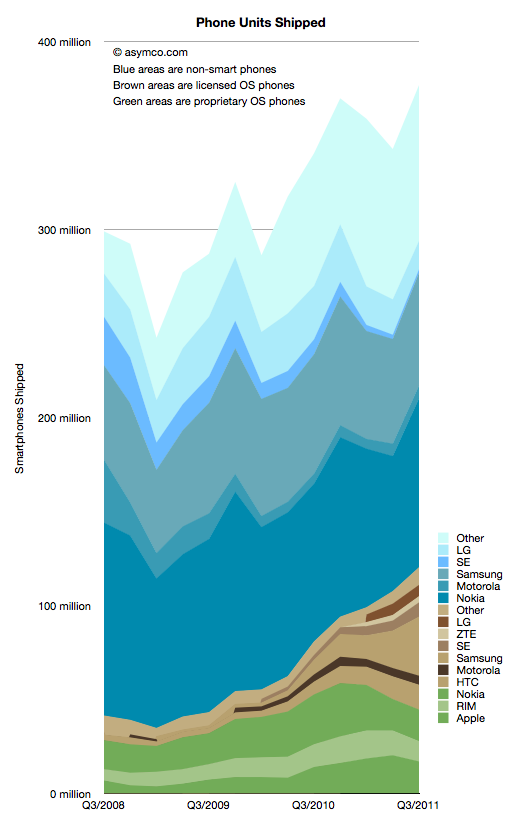
Ok, so you have decided that you will take the jump and build a mobile application or website. And in your analysis, you’ve pretty much established that you already know what kind of content it is that you will serve. So what’s left? Well, deciding who exactly to target your mobile efforts towards is one item. Take a look at this graphic recently produced by Asymco which speaks to the published information about global shipments of mobiles

From this graphic (not to mention the data that went into it) we can get an idea of some potential targets for an application or a website on a global scale. For example, we can see from the blue in the graphic that there’s a considerably larger percentage of persons who don’t use smartphones, though this number seems to be getting smaller on a consistent basis (you won’t hear doomsday analysis of the feature phone market here, the numbers bear this as standing strong for the foreseeable mobile futur – i.e., 3yrs easily).

Coming Down from a Global View to A Regional One

Now, this graphic only helps if you are thinking of rolling out something on a mobile global-reaching basis. For many of you, the reach is considerably more regional, and so information like that which Asymco has provided looks best when put against other data, for example, this information from the IDC:

…In Asia/Pacific (excluding Japan) (APeJ), feature phones recovered in the third quarter on the back of Nokia’s resolved inventory channel issues in China combined with the strong showing of its dual-SIM handsets across emerging markets like India and Southeast Asia. With Nokia fighting back at the Chinese low-end competitors, the proliferation of these smaller brands has slowed as margins hit razor-thin levels. APeJ smartphone growth last quarter was driven primarily by Samsung and HTC, as well as ZTE in China. In Japan,the market rebounded sharply after two quarters of either low single-digit growth or outright market decline following the natural disasters of this spring.

The Western European phone market declined as a result of lower demand for both feature phones and smartphones. The smartphone device type growth was mainly driven by mid-tier Android devices. High-end smartphone growth was negatively impacted by Apple’s fourth-quarter iPhone 4S launch, which caused consumers to delay purchases. Meanwhile, Nokia’s transition from the Symbian to the Windows Phone operating system as its primary smartphone platform led to a transition. Feature phones declined as consumers that replaced their devices upgraded to smartphones while others held on to their devices for longer periods of time. Overall the Central Europe, Middle East and Africa (CEMA) markets showed strong growth due in large part to Nokia’s rebound in the regions. Bucking its global troubles, Nokia had a very strong 3Q11 due to feature phone growth. Its smartphone decline continued, however, but it remained the market leader in the region. Among the niche smartphone brands, HTC did particularly well in some markets, including Russia. RIM continues to make progress in the Middle East and Africa, but fared less well in Central and Eastern Europe…

Read the entire Q3 2011 IDC Press release

Now, this information from the IDC is a snapshot of what’s happening with the entire mobile industry (like Asymco’s data), however gives a more detailed snapshot of what’s happening in Q3 of this year compared to next year, and also considering regional and manufacturer differences. This is solid information, and allows an effort to craft a mobile website or application to center onto cultural and distribution details that are a bit easier to manage (languages, platform focusing, etc).

Identifying Opportunities, Tools, and Your Users

What’s left after this is to look a bit more into what it will take to actually build the mobile application or website. For that information, we have to take a look at a few facts: (a) where are the opportunities, (b) where are the tools, and (c) where are the users.

What are some of the opportunities for faith-based mobile apps, websites, and services?

  • Games
  • Funding (not just fundraising)
  • Group Communication
  • Education
  • Health and Wellness
  • News and Information

Or, what are the categories that see the most application downloads (this information is hard to come by, for example just Apple App Store data here; pulling this together requires some effort)?

Where then can we find some of the tools to take advantage of those opportunities?

Specifically Design for Your Specific User

And finally, we’ve got to define where the users are for our application. Not the mythical user. Not the “if we put an app out there, it will be used because they have a mobile” user. The hard numbers. Who in your communities, areas of influence, have expressed such interest in a mobile solution from you that it has effected the ability of your current media offerings to grow? Or, how has the success of mobile for your competitors/partners driven your customers and stakeholders to question your mobile strategy?

It is here that you will want to start researching your user base (or prospective user base) towards whatever mobile experience it is that you intend to craft. That doesn’t mean that you are designing something to please them (part of the effect of mobile is that you surprise and delight because you offer something people didn’t know they wanted), but it does mean that you have a pulse on what they use, what works, what doesn’t work, and where potential consumers of your mobile lie.

Analyzing your user base might mean digging into information that you already have (website visitor data, attendance data, response data from polls/surveys, etc.). And it also might mean that you need to generate means to learn more about your community (surveys, focus groups, feedback forms for events, etc.). But, you have to identify exactly who it is that will be using your applicaiton. Try creating personas for these specific users and then (before developing anything) testing the ideas that you have against them. Then, when you get to the point of testing and looking for feedback to your application, you have some benchmark against which to determine where you proceed with your mobile activity.

Of course, you don’t have to do this work of figuring out your audience. You could very well be the next Steve Jobs and literally have a intuition towards what will work. You also have to have the discipline to make sure that it does work.

Resources, Encouragement
We have some resources that should help you through this process here. But, as we noted above with looking at your users, much of what you need to know about making a successful mobile applicaiton, website, or service is already within the people you serve. Know them, and you know what works.