Monthly Archives: July 2011

What Are Your Little Used Mobile Features?

Last night, I couldn’t sleep, and so I threw myself a challenge towards duplicating a friend’s recent effort to create a video that could be easily see with mobile devices. However, instead of using a brand new desktop PC (and the nice power that came with it) as he has, I used my Nokia N8 and it’s little used Video Editor program. In less than an hour, I had a video of reasonable quality that would be compatible with just about any mobile device. Before the early morning was out, I created five videos, keeping only three of them.

That got me thinking about our mobile devices, and how powerful they have truly become in recent years. So let’s throw this question out there for your Sunday thinking: what feature of your mobile device do you use the least?

Where Are the Apps Beyond Bibles and Tracts

Summer Coffee Outing - Share on OviI’m under the assumption that we are vastly under-utilizing the imaginations and resources of developers and consumers in the bible apps arena. Sure, there are bibles, reading plans, libraries, audio libraries, and video tracts that are solid for building the faith. But, that’s it. There’s nothing else, unless you are looking in the “kids” section and much of what’s there gets little attention from it’s target audience, let alone the genre.

But, I think this is something that can be solved. We’ve got to look at the potential situations we aren’t addressing and then create the opportunity to grow personally and with one another in a way that would be receivable.

To that end, I tossed some thoughts up at twitter hoping to get some conversation and probably poke an imagination or two. Here are the tweets:

At a gathering there were 3 iPads, several iPhones, and a few other smartphones. Bible apps weren’t the topic. Nor was gospel music. If you want mobile to be an intentional response for faith, you’ve got to build something that threads those social moments, like games.

Am honestly shocked that there’s no game that can be played across multiple devices published by Christian/bible developers. Missed [opportunity]? For as much as Taboo, Scrabble, etc are played at gatherings, why not use mobile there too? Folks already have devices out on social net[works during gatherings]

There’s more than enough subject matter in the bible alone to create a solid mobile game. Where’s the imagination and execution for this? Or, is asking for such taking aspects of “fellowship” outside of a comfy space. If games go social+mobile, do [people] connect/mature faith?

If games for religious/community gatherings go social+mobile, does that break/mend social fences?

There are a few things here, and each could be their own conversation. But, I want to know your thoughts. Why aren’t we seeing more social games targeted towards small groups? For all the funds that many churches are spending on mobile apps that are simply brochures (much like their websites and printed programs), why isn’t that energy being put on making social games that engage their communities on existing social networks, or community-specific one’s?

One project that I came across (tweet) is Ebenezer by Old Testament Adventures. From the website:

Ebenezer is a point & click adventure game in the style of Monkey Island based around the Old Testament story in 1 Samuel 8-12, where Saul becomes king. It is currently under development for iPhone and Android.

For more information, including how this is being put together and how you can contribute or get involved can be found on their website.

So far, that (and Bible Navigator X which we talked about before) seem to be it. Do we just not have the imagination to do on mobiles in faith gatherings what people are already doing in faith gatherings, but might have little to nothing to do with the gathering itself?

The Open Source Almost Answer

An article at O’Reilly Radar sparked a memory back towards a previous post on open source in the mobile ministry (#mobmin) space. Here’s a snippet of the Radar article:

So, if all software should be free and open source, who is going to write this code? One argument is that the dentist, or a group of dentists, should underwrite the production of the code. But dentistry, like most things in western society, tends to be a for-profit competitive enterprise. If everyone gets the benefit of the software (since it’s FOSS), but a smaller group pays for it, the rest of the dentists get a competitive advantage. So there is no incentive for a subset of the group to fund the effort.

Another variant is to propose that the software will be developed and given away, and the developers will make their living by charging for support. Leaving alone the cynical idea that this would be a powerful incentive to write hard-to-use software, it also suffers from a couple of major problems. To begin with, software this complex might take a team of 10 people one or more years to produce. Unless they are independently wealthy, or already have a pipeline of supported projects, there’s no way they will be able to pay for food (and college!) while they create the initial product.

Read the rest at O’Reilly Radar.

We’ve been on the side of open source for a long time here at MMM. From Bible+ to Katana to Biblia to Door43, we are extremely supportive of those persons and organizations who see a need for transparent development, free/low-cost applications and content, and the communities that develop from such efforts. We’ve also been on the side of projects that started with a boom but are nothing more than a whimper (for example, Katana). Starting a project with the idea that it will be open source assumes a lot – and unless you are Google-like (Android was purchased by them and then made open source). You’ve got to have certain ducks in a row, and unfortunately, finances and impact are the major ones where some open source projects fail.

But, there’s a place for going open source after a time. Are  there Bible reader applications who have been in a maintenance mode, or are large enough that a critical mass of interested developers, designers, etc. would fill in some of the blanks such as platform support, languages, and reach? Probably. Yet only a few fall into this category – not to mention the fun of the content rights in this domain. It is an answer, and one that could afford to be better explored.

That only makes open source part of the answer. And as the Radar article is really trying to bring into the discussion, just because something is open source doesn’t mean its free to develop, support, or market. There are always costs, and somewhere, someone pays for this. This could be from donors, this could be from fans. But, it has to be a large enough group that open source ‘X’ makes sense over something that isn’t. When that’s not the case, open source is no more a correct answer than ‘C’ on a true/false test.

Addressing Mobile-Accessible Discipleship Resources with Door43

Door43 logoSo, we do a lot of talking about mobile ministry (#mobmin) with various people, ministries, and organizations, and much of this conversation is great. Yet, there’s always this point in the conversation about resources comes up. The questions range from “how to create mobile-formatted resources” to “what are some of the best mobile resources for [insert your topic area].”

The initial answer for this is that most documents and media is already mobile-friendly – just make it available. On-board email applications and office productivity suites (QuickOffice, Documents-To-Go,etc.) have the ability to read items created in Word and Excel – some can even do PDF and PowerPoint documents (with layout being the chief issue on the smaller mobile screen). Office suites have both read and editing abilities, and so that at least makes the “how to create” question easily addressed.

Beyond that, we get into a harder to address question, “what are the best resources?”. Unfortunately, when asked “what are some of the best,” we get into what doesn’t exist or simply hasn’t been made available in the mobile context such that it could offer some sense of comparison (though things are improving all the time). Thankfully, there’s some good work happening in this area. One group is addressing discipleship resources using a open and collaborative  approach. That organization is called Door43.

From their website:

Door43 is a self-selected, online community that believes in the vision of working together to equip the global church with unrestricted discipleship resources, using the technology God has given us… The Door43 project is open and free for anyone or any ministry to use. The project is managed by Distant Shores Media

With Door43, you have a resource creation, engagement, and sharing space where items specifically related to discipleship is being developed and implemented. The primary project being undertaken right now is the Open Bible Stories project. Open Bible Stories is a collection of 30 stories of the Bible in text and mobile-ready audio and video formats. The project is released from copyright restrictions under a Creative Commons Attribution-Share Alike license (seeDoor43:Copyrights), so that the stories can be legally adapted, translated and used by anyone, in any language and culture. To see the progress of this project, check out Open Bible Stories project page at Door43.

Other pending projects at Door43 include:

  • Open Bible Translation – Help draft and/or check the Open Bible Translation, a version of the Bible in modern English, based on the same texts as most other versions, for unrestricted use anywhere, by anyone.
  • Open Study Notes – Help research the Open Study Notes, a project to create free and open study notes that clarify the historical, cultural and linguistic context of every passage in the Bible.
  • Open Bible School – Write a teaching unit for the Open Bible School, a modular Bible training course in three tracks: Book Studies, History, Doctrine.
  • Open Bible Handbook – Create entries in the Open Bible Handbook, an up-to-date handbook of key Bible terms, topics and maps to help anyone better understand the Word of God.
  • Open Christian Library – Do you have a discipleship resource (like a Bible study, book, training course, etc.) that you want to give to the global church? Put it in the Open Christian Library where it can be translated and distributed to mobile phones anywhere in the world.
  • Open Worship Project – Write a song and give it to the global church in the Open Worship Project.

Of the initiatives that I’ve seen which are pulling together some specific aspect of mobile ministry and addressing it, Door43 is one of the more open efforts. If you are looking for discipleship resources, or can lend your hand to Open Bible Stories or any other project, get in contact with Door43 (@door43) and add to the wealth of necessary resources.

Because, like I said earlier, making resources is easy. But, making relevant resources takes a community effort.

Creating Alternate Fellowship Spaces

I was recently invited on a bicycle ride with another brother in the faith and while we only went 10 miles, it was great to have some fellowship and just chat while putting the feet to the pedals. One of the statements that the brother made is that he wishes that there were more believers around him who liked to bike, as he would love to do this as a fellowship activity. I mentioned to him about some groups of believers that I know who do ride, but there were no in his area. It got me thinking, is there a more effective way to combine an activity like bicycling (or hiking, running, etc.) with fellowship?

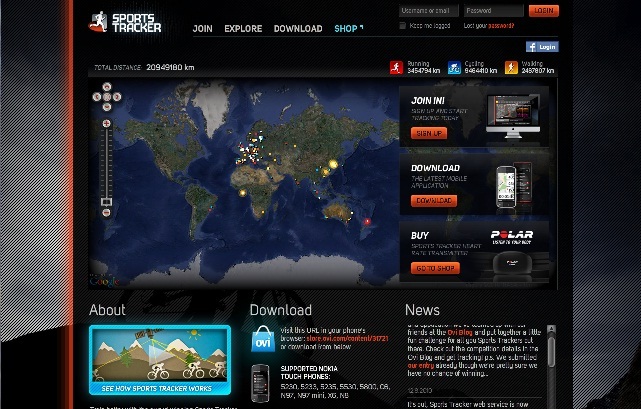
When I finished that ride, I went to the Sports Tracker website. Having pulled a mobile from the grave, I was interested in getting that software working – and it didn’t before the ride. And then it hit me. Sports Tracker is a social network, and literally, my mobile (and the public rides) would present a means for other believers to connect with me as I ride. It would just be a matter of advertising both to those who use the service, and to those who don’t.

Essentially, I’d just need to ride, and then make sure that my rides are shared publicly with titles that would indicate that those rides were fellowship based. Then, I could use other social networks (online and offline) to talk about the rides. The mental note for me would be to make sure that I turn on Sports Tracker before the ride, so that its being logged. But then, its just about riding and fellowship.

I’m sure that other applications and services could be used for similar. Its just a matter of being creative around some of their abilities. And if you’ve got something that works with a mobile – even in a simpler fashion like sending a group SMS out to your small/cell group a few hours before an outing that some might also want to join – then you’ve made your mobile a catalyst for connecting with others.

I’ll try this and see what happens. In the meantime, have any of you tried something similar with social networking or mobile in order to create a space for fellowship that’s not the usual breakfast/bible study/(gender) group event?

Sports Tracker is available for Nokia Symbian, Google Android, and Apple iOS devices. Its a free download and a free service. For more information, visit the Sports Tracker website.

After You’ve Gained the Knowledge, Then You…

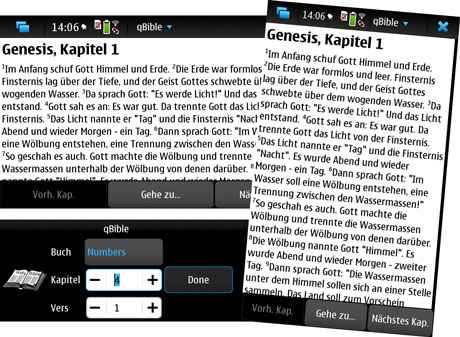
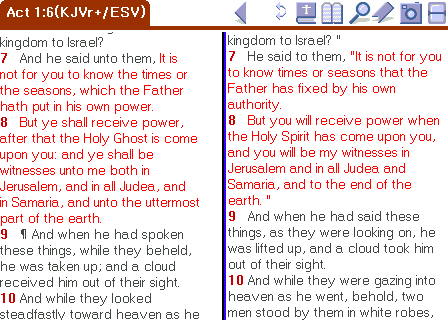
Image: Dual pane view of Bible+ showing KJV and ESVA recent tweet by the Folks at Audio Bible/Faith Comes by Hearing (@audiobible) got me thinking (again):

If u could carry the Bible around with u in more than 500 languages – like in your pocket – how would u use it? #Hmmmm #GreatCommission

Original tweet.

I used to carry 1, then 2, then 15, and at one time over 100 Bibles around with me on my mobile devices (thanks Bible+). At the time, I justified it because I was (a) reading/studying Scripture a ton more than I do now, and (b) I interacted with several people who “heard” the Scriptures best in the translation they most used. Being that I was also at college during this time, it felt like the right way to approach speaking spiritual matters in a clear and consistent manner (1 Cor 14:1-19).

I don’t carry as many Bibles with me these days. In fact, until recently I didn’t carry any versions on my mobile (still no app, but I’ve got a Bible), and the ones on my iPad are the same in each Bible app or website (ESV, KJV, NET, and a few others). I’ve got less a need to carry as many versions of the Word as I do the onus to live as much of the Word so that when asked, I can give the appropriate answer to my faith (1 Peter 3:15-16). That, and the consistency of being in or near connected spaces allows me to search quickly from a series of websites when needed, or just make a note for something to come back later to.

That’s not the case for all folks. Many of the frequent travelers and missionaries I’ve met would jump at the ability to have Bibles and other texts in as many languages as needed, and at a moment’s notice. Their interactions almost require it of them. And when they are able to have something that speaks right to their audiences, it makes living among mixed groups that much easier to manage. When they don’t have that content, or even the ability to get a clear translation, their relationships to people and environments suffer.

But such use speaks to that end of things – where the tweet asked “how would you use it?” Many of use have libraries of Bibles and other content in print on bookshelves (digital and otherwise), but what have we done with it besides making it decorative? Have we taught someone to read, or took the time to use those resources to tutor people who are studying those subjects we’ve collected? Have we engaged the cultures beyond the pages and held the kinds of conversations that would amplify or change our opinions of those cultures, people, and events? Or, is it just a number?

In grade school, many of us learned about the terms kinetic and potential energy. Kinetic energy is identified by its impetus to move – the energy immediately before movement happens. Potential energy, on the other hand, is energy that is stored and is usually static due to its position or configuration. You’ve got that neat Olive Tree, Logos, YouVersion, or Bible.is app with hundreds of Bibles and other materials ready to be used. Are you in the process of transferring that energy into the lives of others, or are you configured simply to display the potential of what can be?

Giving Away a Mobile to Give Into Opportunity

1 to Have, 1 to Review - Share on OviOver on my personal site, I wrote a pretty long piece talking about me giving away the Nokia N97 that I’ve had for the past two years. I’m quite at peace with giving it away, but not for the reasons I used to give away mobiles. Here’s a snippet:

…Then the N97 leaves my possession. I’ll have only two mobiles, the X6 and my N8. The X6 might stick with me since it has a crack in the screen – unless someone comes along that needs it more than I need to keep it as a backup. I’m not wedded to keeping so many mobiles anymore (as I said in an earlier post). But, I’m also not content in people just getting a mobile for the sake of having it. These devices should enable something more than simply calling or texting someone. It should be more than saying “I’ve got screen, after, screen, after screen of applications that I rarely use.” No. These mobiles should connect us to the things that matter. Educating one another, preventing disease, sharing our spiritual travels. These are the things that matter, and what mobile should foster.

For me, I’m clearly in a phase of life where if it doesn’t improve someone else’s life in those kinds of ways, then mobile doesn’t matter. If all it does is sit as a trinket, then I might as well give it away to someone who can change the world with it much more than I.

Read the rest at Blog.AntoineRJWright.

It has been a good while since we’ve talked about giving devices away and contentment. What are your thoughts on the subject? Do you think that the way we view mobile and technology lends to grow into these kinds of decisions? Or, does some aspect of consumerism or security override those moments?

Poked the Mobile, Then What

Two articles the past week have got me asking the question of “what’s next after we’ve poked the mobile?” After we’ve built the app, created the service, or even built the curriculum, what then?

The initial spark to this thought came via an article at Church Mag. Eric Dies posted about an excellent take on utilizing the entire capabilities of the iPad (hardware and software) and combining it with a multi-layered and interactive story to create something that just can’t exist in another medium. The Fantastic Flying Books of Mr. Morris Lessmore was created by an ex-Pixar artist, but really points to what’s possible.

I left that article going “wow, amazing take on storytelling. What’s the kid/adult going to do when the story is over?” You can’t just read a story that engaging and then be done – what next? I feel like that after some passages of Scripture. I’m not so much looking to go back and read it again as much as I’m inspired to live differently.

The second spark came via a Wired article (How Khan Academy Is Changing the Rules of Education). I don’t have kids, but I did have parents that would have jumped all kinds of hoops to put that kind of material in front of me. I constantly needed to be challenged in school, and it reflected in both the positive and negative. A resource, no matter how crude, that can or does constantly adapt itself to the reader/student would be excellent – and (as pointed out in the article) make some skill-sets more developed faster than others.

It also leaves the question though of “what next?” What happens when a child/student gets past all the levels, unlocks all the achievements, and (for all intents and purposes) can game the system to just look busy? The Khan Academy surely does show one possibility of filling in a gap – but what it cannot answer is how do you take this person who’s now prepared earlier than normal and make what they’ve learned culturally or socially relevant while not reinforcing the gaming methodologies they learned?

So, back to the initial point – I’m looking at the bible apps, tracts, social networks, and such, and going “this is good, its here. Now, what do people do next?” If you will, if the presentation on a mobile was so engaging (which was good if we were using mobile as a channel to rebroadcast materials), to whom are they empowered to teach/disciple? Or, if they finished the “Rosetta Stone of Scripture lessons,” are they now equipped to lead a small group, integrate into a local church or para-church organization to take those lessons to a wider audience?

Don’t get me wrong, I’m not saying that every mobile ministry activity has to think beyond their purpose or niche. But, there is a responsibility that if we are enabling, teaching, filling a channel, or even distracting from another media element, that there’s something next that we’ve got to be ready for. Are our pastors and teachers ready for the life that mobile causes? If not, should some of us be putting our energies there, not simply into the bucket of “go mobile because its the thing to do?”

What are your thoughts? Should mobile activities in ministry have some perspective of “what’s next?”

WIP Releases July App(lication) Store Report

The Wireless Industry Partnership has released their July App(lication) Report. Here’s a snippet of its summary:

Looking through many of the major app(lication) stores reveals a few things that haven’t changed all that much since the days when carrier WAP portals dominated the mobile content business. In particular, the dominance of larger app makers in the top-download charts and in the “featured app” slots harkens back to the days when the biggest winners in the mobile content space were the companies with the best biz dev teams, not the best apps and content.

Some app(lication) stores, such as the iTunes App Store, do a decent job of highlighting content from lesser-known developers alongside the big names, but the reality in most stores is that it’s truly a long tail game. Like in so many things, the 80/20 rule provides a good rough estimate: in this case, 80 percent of the apps are sold by 20 percent of the providers — leaving the other 80 percent of developers fighting over the rest of the market.

Read the report (PDF) at WIP Connector.

Mobile Advance’s 10 Questions Series: Alex Kerr

Mobile Ministry Forum - Share on OviOver at Mobile Advance a new interview series called 10 Questions. Here, Mobile Advance interviews people involved in and around mobile ministry activities.

The latest of these interviews is with Alex Kerr from the UK. Here’s a snippet of that interview:

5. What are some of the biggest obstacles to implementing effective mobile ministry? For you/your ministry? For the Christian world in general?

A couple of things I think need to be overcome in mobile ministry in general to see it being as effective as it can be. Firstly, a raising of awareness amongst churches globally that the mobile phone is a channel to reach people in general, and especially youth (though most certainly not limited to them). I know big, globally known churches, that don’t even have mobile on their radar. It does depend who your audience is for a particular outreach – maybe mobile really isn’t appropriate for something – but generally I think awareness needs to increase considerably, just so it’s at least on the table in people’s minds as an option (along with other routes to reach people)…

Read the rest of this interview at Mobile Advance.