Monthly Archives: March 2011

Parenting in the Digital Age

Is parenting is the most apparent form of discipleship? There always seems to be lessons each generation learns that the previous didn’t have. Such is the case these days with the use of digital technologies and how parents (who might not be so native to aspects of digital living) and their kids (who also might have their challenges, but not the same background of experiences in other channels).

There’s certainly a reconciliation of experiences needed, and we’ve covered as much in the past within our Parents and Mobile Kids Report in 2008/2009. Yet there’s always newer and clearer takes on the subject, such as the upcoming God’s Technology video from HeadHeartHand Media. Here’s the trailer:

God’s Technology Trailer from HeadHeartHand Media.

What kinds of resources have you come across that have helped you relate your values of life and faith to kids (your own or others)? What have been some of the challenges in doing so?

~ via Don’t Eat the Fruit

The Layers of Mobile Life

One of the points that we tried to get across in our BibleTech presentation is that there are several layers to mobile life that need to be understood if mobile ministry initiatives are going to meet with any success. Part of understanding those layers is indeed the relationship between mobile and faith. Another perspective of the layers of mobile life comes from the marketing and analytic fields.

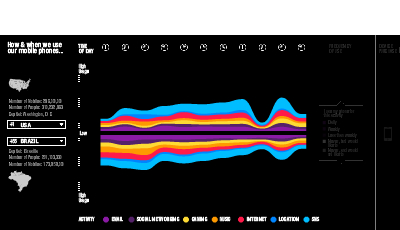
For example, the results of a mobile life survey by TNS Global Marketing displays some of what could be understood from following, or not following trends in mobile.
screenshot of USA and Brazil mobile life comparison via Discover Mobile Life/TNS
See this in more detail along with other visualizations of the Mobile Life survey data from TNS’s Mobile Life website.

Just as important as these observations are, understanding mobile living also has to be considered from the viewpoint of what’s happening on the ground. There’s not as much data from those areas, so we are good to rely on reports such as Mobile Active’s How Small World News Trains Citizen Journalists and Captures Footage from Libya and the book Where Are You Africa?

Trends analysis (such as this one recently posted at Wireless Week) helps to get an idea of where to focus towards, and also where to look for those spaces where data is or can be best interpreted. You don’t base products or initiatives on those trends though. Trends – like prophetic versus in Scripture – need to be interpreted in light of the context in which they are given. And especially with some mobile trends’ data, you will want to get below the high-gloss level of trends to what’s actually happening as we talked about in the items above. That said, you can do a lot worse than Chetan Sharma‘s data – his work in this space is really well founded.

For mobile to be better utilized, this kind of research and data is needed. And from these efforts can sprout the kinds of insights that enable people to engage mobile not just as a layer to their lives, but as a wand to create better lives for themselves and others.

The Congregation as *nix

Note: If you don’t know what *nix is, this post will utterly confuse you. Instead, let’s go get coffee and chat.

Being part of a Christian congregation is frequently frustrating for me. This not because I don’t love the people, nor is it because I look at the congregations I’ve been part of and think, “Who needs this?” Rather, the frustration comes because most of our congregations are set up with systems that work the world of the mid 20th Century. There are multiple boards, various levels of permission structures, and several territories which must not be touched, looked at, or mentioned. I’m not wired to work that way. If there’s a good idea out there, I don’t want the person to sit around wondering which board as the authority to “give permission.” If there’s a (typically dusty) button which says, “Do not push,” well… that thing’s getting activated! I tend to be a rooted individual, personally, but when it comes to group interaction I’m wired for a more dynamic reality. To me, a congregation should be POSIX compliant – it’s a *nix.

Operating systems that are POSIX compliant (such as Unix, Linux, and BSD) are wonderful things. Instead of creating a huge, tightly-woven, thread of processes which are mostly “all up” or “all down,” a *nix system has lots of little processes which do one thing, and can be tied together to performed larger tasks. If a process is not needed, it can be shut down and the system will keep running as normal. If you’ve ever had to re-boot a windows machine when you change the network name, installed a driver, or updated the network settings – you’ve see what the alternative to a *nix is like. Everything runs at the same time, and to restart (or alter) one aspect of the system requires the entire thing to be temporarily inaccessible. In a *nix, you simply turn the one process off and then back on.

The Church, over the last 60 years or so, has been more like Windows than *nix. Or, rather, it’s been more like several windows machines trying to collaborate on multiple tasks without networking. So, if an idea comes in that needs a new process to run – the Church (metaphorically) looks for the system that has the closest approximation to the idea and then “installs it there” (usually by a board appointment). The promise is, in a sense, “eventually we’ll get the software needed to do what you want – but until then you want to stay at this system because if you aren’t here when we get to it you might not get to use it.” By the time the one system (i.e. board) is ready to act on an idea the users figure out that they need resources on another machine – only to find that’s it been shut down, and all the people who know how to access it have gone home for the month. If the users of the first system remember to bring up the idea with the users of other needed system when they come back (a month later) it is usually found out that the data (the proposed idea) from the first system isn’t compatible with the data from the second system. Then the first users are sent back to reformat the idea into a language that works on the second system. By the time this is done, the users of the second system have shut it down and gone home – for another month.

It is in this way that congregations put new ideas to death. It’s what I refer to in another metaphor as, “The Bureaucratic Nightmare.”

Now, instead of having several systems (which constantly have to be rebooted every time you even a slight change) I like to think of the Church as one system with many processes going on – like a *nix. These different processes can be turned off and on at will, and are designed to work together in order to accomplish larger functions (that’s the beauty of POSIX). If there comes a time where a particular process is no longer needed, it can just be shut down completely – allocating the resources it used to other processes which are needed. This creates a dynamic reality that can flow with the current situation.

There are two things about this idea that I want to share.

First, while I am frustrated by the “Bureaucratic Nightmare” which exists in many congregations, I don’t want us to consider the people who came up with that type of system as unintelligent. The systems created by a Bureaucratic structure worked when they were developed. If they hadn’t, they would have never survived. In fact, at least in the context of Western Civilization, I’m certain that the structure I’m naturally wired for wouldn’t able to function at all prior to the advent of mobile technology. It’s mobile, and the arrival of “pushed” data, that creates a human-network where small specialized processes (the ideas people have) can be easily tied together to accomplish larger tasks. Before mobile, a *nix metaphor for a congregation would end up hanging while data waited for someone to get home to answer their voicemail and, if it wasn’t too late, call back. With mobile we can send out a request and expect to receive a reply in minutes, if not seconds.

Second, even a *nix has an underlying core, or kernel, which governs all the processes on the system. The kernel tells all the other processes what resources are available, and sets boundaries for the processes running on the system (among other things). In a Christian congregation, our kernel is the truth of God revealed in Jesus Christ – the Gospel. That kernel is what keeps us “running” – and without it we wouldn’t be a Christian congregation.

So, here are my musings. Enjoy, and may your reboots be few and far-between.

This item was previously posted at Painfully Hopeful
Defining the Specifics: Spiritual Implications of Mobiles in Ministry

Elements of the 21st Century Waterhole - Share on OviIn previous articles where we’ve looked at some of the applicable contexts for defining mobile ministry, we’ve only lightly touched on the specific discussion of Spiritual Implications. However, we did start with a focus:

theological constraints/precedents; psychological/cultural effects of mobile vs. other personal/connected technology media elements

So what are some of these in a bit more of detail? Let’s explore a few memes:

Theological Constraints/Precedents for Using Mobiles in Ministry Contexts

John Dyer (Don’t Eat the Fruit) posted about the 10 Commandments as a communication event, here is a piece of that post:

…The Israelites might have argued that the technological means they used to approach God didn’t matter as long as they were devoted to him and him alone. But God begged to differ, because he knew that the instruments we use for worship always reinforce certain beliefs…

Through our lens of today’s computer technologies, what becomes of the rules and the methods that we used to govern other types of technologies (communications – with an ‘s’)? Does the teaching of language structure, cultural context, also bring into the understanding of the shaping of the message and how a message heard in one context (for example Twitter) can shift or change the effectiveness of the entire message? Or, in looking back at Dyer’s piece, why didn’t Moses come down from the mountain with tablets for all 2 million persons? Surely, it would have taken longer, but wouldn’t the message been easier to keep with them? Or, was the device not the point, and there was something greater with the message that needed to be taken in that we sometimes miss when we take our churches into the realm of social media.

There are theological questions here. Let’s dig.

Psychological/Cultural Effects of Mobile vs Other Personal and Connected Technologies

We can also look at those spiritual implications as matters of culture and psychology that effect us on another level. Surely, getting an SMS conjures up different response mechanisms than seeing a paper mail message. An article that I read recently put forth a figure-ground relationship not just to technology, but how are technological affects are effecting how we understand and maneuver through history. Here’s a piece of that article that I found relevant and leading for this kind of discussion:

…The biblical archetype for hunter-gatherers has traditionally been the Garden of Eden. Savages are minimalist predators, and simply live off the bounty of nature, in areas where it is effectively inexhaustible.  To the extent that their gathering has evolved into agriculture, it is slash-and-burn agriculture based on immediate consumption and natural renewal rather than accumulation and storage of vast quantities of non-perishable food over long periods of time. You could call their style of farming “nomadic” farming, since they move from cultivating one cleared patch of forest to the next, rather than staying put and practicing crop rotation in a small confined (and “owned”) patch of land.

For the record, I think the Garden of Eden story has it right. Savagery is the most pleasurable state of existence, if you can get it (until you annoy the witch doctor or get a toothache). Not in the sense of noble savage (an idea within what is known as romantic primitivism that is currently enjoying a somewhat silly revival thanks to things like the Paleo diet), but in the sense of what you might call the idle savage state. In some ways, an idle savage is what I am, in private, on weekends…

And here are some of those psychological thoughts, some that shouldn’t be divorced from the understandings that we should get about spiritual implications of mobiles (all tech) in ministry.

I admit that some of this gets incredibly philosophical and academic, and to some degree might even by why spiritual implications might not as well developed or explored as other areas of mobile that we’ve looked at. And yet, I am determined to mine the available understandings and thoughts present so that there can be some merit towards our efforts in mobile/social web. Maybe then by penning some of those thoughts and observances, we can corporately better direct ourselves – and the world at large – towards the kind of thinking that is more proactive than reactive.

What might some of your thoughts be here? Surely, I’m not the only one thinking about this, but there should probably be a better (pastoral, theological, etc. framework) given to this segment of thinking that I’m missing. Let’s chat, let’s learn together.

BibleTech Presentation – Mobile Ministry: Definition, Contexts, And State Of The Body

QR CodeUnfortunately, funds and life have prevented MMM from being present for this year’s BibleTech Conference. There is always a lot of interaction, fellowship, and techie talk that happens, and I’m totally sure that by this point, I’d be recharging my mobile for the 2nd time in the day.

Mobile Ministry: Definition, Contexts, And State Of The Body happens to be a timely topic seeing that now many ministers and ministries are seeing that mobile is where they need to be and asking questions of where in ministry mobile fits. This talk recenters the context of mobile around the term mobile ministry, and then points to where mobile has been demonstrated in a ministry context.

In some respects, this presentation answers why MMM was started in the first place (to answer the question of what the Body is doing in mobile). And as such, gives the focuses to mobile ministry areas which might have been addressed, but maybe not as strongly because of the youth of this tool/channel.

View the Presetation (or scan/share the QR Code). The meat is in the notes (viewable by toggling the “slide view” (Ø) symbol at the bottom right of the screen). Per our usual BibleTech presentations, the information in the presentation is designed for consumption and mobile interaction.

(Abbreviated) Live Presentation via Qik

Blame a few folks for thinking that it was possible, and me for taking it further than my hardware and experiments usually go. But here’s an attempt to do this presentation via Qik. You can see the live presentation below, or visit http://qik.com/arjwright and then click on the video noted Live. If you have the Qik app, you should be able to interact with the video stream there.

This is being done over a Wi-Fi connection and using the lower-resolution front-camera of my Nokia N97. I’ll do what I can to keep this interactive, but I’m also really, really experimenting here. If it fails, BibleTech again gives some lessons learned and applied.

As for the rest of BibleTech, catch it on Twitter (#bibletech) and we can chat about what’s next in mobiles for Bible studies and other ministry endeavors along the way.

Some Friday Goodies

Breakfast before Day 2 - Share on OviJust a few items to note on this Friday:

BibleTech Presentation Preview

BibleTech logoSeems like that for the past two BibleTech Conferences, we’ve gone the route of giving a sneak preview of the presentation. Might as well continue the tradition. Here’s a snippet from one of the presentation slides:

Definition of Mobile Ministry

The skillful use and application of computer technology classified as mobile for the context of fulfilling the religious practices which forward the proclamation of the key ideals and history of the faith, following form to and innovating on top of cultural and faith traditions within applied contexts.

The defintion that we are using here for mobile ministry is curated from several sources/leanings. First, the idea of skillful use being made clear in Proverbs 4:7 – wisdom in using mobile isn’t the providence though of Christians, it should be the hallmark of all people using this technology or engaging in its benefits.

Secondly, in calling it an application of computer technology, we are divorcing the behavior of mobile from other mobile-like behaviors such as listening to music via a walkman, or even limiting the tool to that of a mobile phone. As stated in our formal article on this defintiion, mobile inlcudes any kind of computing technology which is not bound to a specific space, and has usage models which fit within these 8 recorded unique characteristics.

Because we use the appended term ministry we are also filtering the use and application of mobile to faith practices. Certainly, there is mobile beyond faith, however this definition is deliberate to describe mobile technology in this context only.

We use the phrase forward the proclamation of the key ideals and history of the faith as any use of mobile in/for minsitry has to contain the scent/fingerprint of profitably carrying forward the tradition of fatih, while also growing the understand of living within the concepts and ideas that were originally set out when the Christian faith was understood to be codified.

Lastly, we use the phrase applied contexts because we understand that mobile and minsitry are bound and loosed within specific environments – and no two appliations might give the same result because of the characteristics of mobile. That also means that mobile ministry is more than a theoretical exercise, for at some point all faith (theory) must be lived out (proven) and vetted for justification as profitable to the faith, and to all humanity.

Well, this is at least how it looks on (digital) paper. I’m not sure that it will come out this cleanly.

If you are able to make it to BibleTech (and this includes us at the time of writing, its been a rough go of things for a bit), am looking forward to connecting, fellowshipping, and (possibly) being late/missing a few sessions because of great conversations.

If you aren’t able to make it, we’ll still post the presentation here (at the same time I’d been scheduled for just to keep it in tune), and we can converse over Twitter with the implications of what’s in text there.

For more information about BibleTech, check out the conference website.

Sewing Up Gaps in Mobiles Shown During Emergency Situations

I am glad that we are now at the point of understanding that the characteristic of a mobile to be present – cellular service or not – during emergency situations can be the difference between life or death in all too many cases. Once those situations are over, and even sometimes in the midst of them, we can find ways that mobile and connected services can and should be used to help the efforts to address health and aid.

What has been noted though is that there are gaps in the knowledge of what has been and can be done. Yes, some of that is because in an emergency situation, there’s no time to document what it is that was done – its was done and lives were addressed. However, there are opportunities to learn from situations that we’d be remiss to not learn from and be better prepared for future emergencies. For example, there are many mobiles in Japan which aren’t just stylish, but also waterproof. The industry and government understood that for some of the people who use mobile services, it could very well be a possibility that the device/service would be the contact point. Making sure it worked after being submerged meant they worked that into devices that were easy to understand and use.

Over at 3G Doctor, there’s a list of things that can be done on or around mobile devices/services that will help to manage (future) emergency situations. In summary, these are the items:

  1. Educate every member of society about the use of mobile
  2. Provide Aid (i.e., donations)
  3. Identity (i.e., blood donors, live register, etc.)
  4. SMS (i.e., warnings, knowledge sharing, etc.)
  5. Location-Based Services (i.e., resource deployment and monitoring)
  6. Video Content
  7. Utilities (i.e., Backup/Alternate Power)
  8. Hardware (i.e., waterproof devices, biosensors)

Read the entire article at 3G Doctor to see how these are explored.

If you are involved or have been involved with organizing or addressing emergency situations (such as Japan, Haiti, etc.), where has the availability of mobile helped? And what could have been better done?

From those lessons comes where churches and other ministries can and should step up to fill the gaps.

Using the iPad 2 in Ministry by Painfully Hopeful

Wes Allen has recently purchased an iPad 2 – significant because he purchased the original iPad for his son and has some watching it in a specific use, while also playing a role of occasional software tester and support person. Here’s a snippet of what he plans to do in ministry with his iPad 2:

…Second, I’m going to use this during worship as my complete information repository. As a pastor, the sheer amount of paper I have to carry into worship is staggering. I have a bulletin, all the inserts, my Bible, my lyrics or hymnal, and whatever last-minute added things people want to make sure I don’t miss. It’s insane. With my iPad, I’m down to one device (actually two, my iPod touch. Is my remote clicker) – it’s my Bible, my lyric sheet, my worship bulletin, my announcement sheet, my notebook for last minute information, and my prayer concern recorder. This is so much easier for me, with the added benefit that the information I take in when I’m with the community doesn’t end up in the recycle bin (after which I find I need to access it agin)…

Read the rest at Painfully Hopeful.

Now what about you? You might have watched others with the first generation iPad, and have taken a jump into iPad 2. How are you looking to use it in ministry? And what have been some unexpected surprises so far if you have purchased one?