Archive for February, 2011

Infographic – The Internet in 2020

Thursday, February 17th, 2011

Internet_In_2010Around this time last year, a slide show looking at mobile trends for the next 10 years was released to wide acclaim and conversation. The amount of contribution and conversation around this effort spoke loudly to where many people see mobile, web, and other computer technologies going. We even posted our take on these trends, focusing on specific implementations to faith communities.

This year, we’ve got another info-graphic to poke your mind towards the Internet as it would look in 2020. From the folks at Intac, there’s a lot on here that’s not always easy to see in pictures. Here are some of the points noted:

More People Will Use the Internet
In 2010, there are 1.8 billion Internet users and a world population of 6.7 billion. In 2020, it is estimated that there will be five billion Internet users.

The Internet Will be More Geographically Dispersed
The estimated world population in 2009 was 6,767,805,208. The estimated number of Internet users on December 2000 was 360,985,492. The latest data shows the current number of Internet users at 1,802,330,457. The penetration of the Internet into the population is 26.6 percent. The growth of Internet users from 2000 to 2009 was 399.3 percent.

The Internet Will be a Network of Things, Not Computers
Today, the Internet has 575 million host computers. Expect billions of sensors on buildings and bridges to be connected to the Internet by 2020

Lots of things here, and much of it aligns with what we saw in last year’s report. What sticks out for you? Or, what doesn’t go far enough?


Open Source as Ecosystem not Just Platform

Wednesday, February 16th, 2011

Thanks to the announcement of the Nokia-Microsoft partnership, I’m getting another one of those chances to think about open source and closed (curated) platforms and ecosystems. There’s always rumblings in the digital faith space about open source and how it can play a role as the/a answer to issues and reach, but too often, I’m hearing open source pitched as a platform solution, when the issues with evangelism, missions, etc. have more to do with ecosystem impacts than just platforms.

It is my opinion that the shift that the Nokia/MS partnership heralds is this acknowledgement that ecosystems are the next playing field for mobile, not platforms. Not that platforms (and the developers that come with them) aren’t important, but that their role isn’t any more important that issues of access, logistics, and flexibility to response.

When it comes to digital faith, we have several platforms (electronic bibles and music to name a few), but very few real ecosystems (the function and nature of Bible societies, and to some extent publishing companies, fills this view nicely). Centering just in on Bible societies for example, it isn’t just the distribution of Bibles, but the curation of faith through social programs, translation services, assistances to for- and non-profits, policy management/lobbying, and (hopefully) the sharing and maturing of believers who define faith first by belief in Jesus Christ. In a sense, they are a hub of several types of activities – so just advocating “go open source” doesn’t meet how they can respond.

Going open source with the disemenation and distribution of Bible texts could be part of their solution – when the matter of network assets, logistics, printing, and analytics has been answered. Going open source where the text (video and audio) can be structured and openly built up can be a solution – when the matter of monetizing the work so that those translating and making those structures can feed their families has been answered. Going open source with the hope of participation isn’t the same as already having community involvement in other aspects of fellowship (digital or otherwise) and opening up a further work doesn’t stress community threads. If you will, open source anything doesn’t matter – its how going open (shared duty, accountability, and responsibility) effects the other spokes of the wheel.

As I tweeted recently, “mobile open source initiatives need to not just answer the platform questions, but ecosystem relevance (whether tied to others or on it’s own).” In respect to digital faith initiatives, we’ve not only got to be able to say “go open source,” but identify the impacts that doing so will endear to current ecosystems. It might be the case that going open source for a platform in the chain will disrupt the entire sea – knowing this, and then helping individuals, ministries, and organizations navigate life afterwards is not just a mobile opportunity, but a key to displaying service as technology’s fingerprint to ministry intiatives.


Forgiveness

Friday, February 11th, 2011

There is a certain catharsis that hits our soul when we allow forgiveness in. An unforgiven  heart holds us hostage, held in the stage where the grievance happened. For some it can take a day, for others it can take years to offer forgiveness. There is not set recipe for how we are to forgive, we are just told to do it. Matthew 6:14 says “For if you forgive other people when they sin against you, your heavenly Father will also forgive you”. It is hard. We want justice, we want vengeance. Doesn’t someone see what they did? Yes, someone does.  He will take care of it. We loose our sense of mobility when we get caught up in the when’s and the why’s. We do not move forward.

There is a flip side of this coin. We are humans and so often need to be forgiven of something. I am not a person who does anything half way. When I do something, I either do it big or I fail big. I haven’t learned a middle ground yet. When I burn a bridge (or person who is on the bridge) I do it in massive portions. I wondered why I could not move forward.  I kept trying but was pulled back several times. I had to turn back and apologize. There is no where in the Bible that states God’s forgiveness is dependent on the recipient reaction. They could shut the door on you and that be the end of the conversation. They are in control because after all, they are the ones who were hurt. The release in us comes when we say those words “will you forgive me”. Four words that humble us, bring us to our knees and acknowledge that we are not as infallible as we like to think.

I offered those words this week. The outcome was so much greater than I ever could have asked for. I am now able to move forward where God wants me. I am now able to re-create bridges that I thought were long gone. The person who received an apology can heal, knowing that their pain was acknowledged and avenged. There is no loosing in this situation.

I was encouraged this week by God’s mercy and grace. If they could forgive me, how much more has the Father forgiven me?


Mobile But Not Quite Relevant

Thursday, February 10th, 2011

Flipboard from Mobile Ministry ForumIn a recent meeting with some people about the kiosk project, a perspective came to light that could probably be best addressed with the statement, “yea, and.”

We were talking about the method of delivering content by way of removable memory cards, but in the midst of the people whom I was speaking, only two of us had devices that had such a feature. While explaining that the kiosk also had a wireless hotspot aspect to it helped things move forward, it hit there that many opportunities for mobile engagement are at best left behind because its difficult for people to take it from a piece of technology to a relevant tool.

Finding relevancy for mobile (or anything) can be as simple as asking questions around what are needs and opportunities. Statistics help here, as do understanding the lay of the land within and without religious contexts. Unfortunately, not too many projects lend to doing all of this kind of work. Many times, we dive into a project without a clear-enough understanding of all of the points of relevancy, and therefore end up posturing mobile (or anything) as a savior, when to the people we are pitching it to, it just doesn’t fit.

In another project from the same week, I received some excellent feedback about the class that I led, “offers great content but would like to have seen the training more targeted towards our immediate needs.” The subject matter was needed, but overall relevancy was lost because I didn’t have key information about the class participants which would have better driven the content application. I put the blame of this one on me, despite working with another company on this one. As a trainer, if the technology that I’m teaching is relevant, then where engage it must be in a place that’s personal to the persons listening.

So here’s the lesson. We can go mobile. And in fact, we’d tell you without thinking about it twice that going mobile(-firs) is probably the best thing you could do. But, if you are looking for the best use of your time and resources, and would rather not want mobile or anything else to fade faster than it started – pick the key relevant points for mobile and the effort you are engaging in. You will not only be relevant, but have a better chance of doing something that sticks.


Tomi Ahonen Mega-Post on Becoming the Next Millionaire Mogul in Mobile

Wednesday, February 9th, 2011

Tomi Ahonen has been quoted several times on this site as many of his insights have contributed to the understanding and application of mobile technology in the digital faith arena. Suffice to say, when he puts an idea down, it’s worth reading, rereading, and making steps to adjust.

Such is how I feel after having read his latest 20K+ word article about the mega-opportunity in mobile. Thankfully, Ahonen speaks in more than monetary terms. And given the insights he and several others in mobile share, the opportunity in mobile for great gains is just a matter of capitalizing on the opportunity. Here’s a snippet of the article:

MOBILE IS BIGGEST ECONOMIC OPPORTUNITY (EVER)

Now, that is a massive statement, isn’t it? I mean, biggest? Ever? But before you jump to your next task on your to-do list, please consider just this fact. One industry on the planet has to be it. All others pretend, but factually, one of the thounsands of industries does truly have to be the biggest economic opportunity of any one time. Earlier on in the past century it was oil. Created the oil barons and billionaire oil sheikhs. Late in the century it was personal computers. Made Bill Gates the wealthiest man on the planet. At any one point in time there is one industry which is the best to be in. (and yes, even if biggest at one point in time, is not guaranteed to be ‘of all time’)

Today that is mobile. Mobile has become a Trillion dollar industry. Not the biggest industry on the planet, but one in a very rare category to pass the Big T of a Trillion. Television is not that big (has never passed half a Trillion dollars in annual revenues). Computers are not that big. Radio is not that big. The internet is not that big. Cinema is not that big. Newspapers is not a Trillion-dollar industry. Neither is air travel, credit cards, advertising, music, pharmaceuticals, hotels, videogames, the coffee industry, etc. Imagine if you were there to be one of the big ‘barons’ of one of those industries when they were in ‘hypergrowth’ stage, you’d have retired rich today with probably universities, airports or even cities named after you…

Read the rest of How You Became Next Mogul in Mobile (and a Millionaire) at Communities Dominate Brands. Also, you might want to add a cup of coffee or tea and a sandwich for this one (the reply from Martin Geddes, then Tomi’s reply).

For something a bit shorter, but packing a similar punch, check out this interview of Tomi Ahonen over at Mobile Zeigeist.


Realistically Estimating Impacts of Mobile Ministry Initiatives

Monday, February 7th, 2011

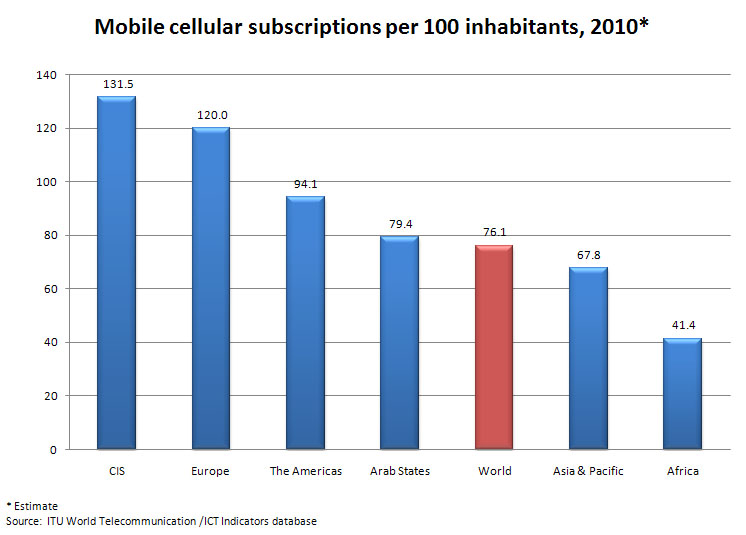
Bar graph of Estimated Mobile Cellular Subscriptions per 100 Inhabitants by World Region, via ITUWhile working on some admin needs for MMM, I came across a question that has had me on a bit of a rabbit trail and a genuine assessment of mobile ministry. The question simply asked, “what is the addressable market?” Included in this answer is understanding who and how many of that “who” can be met by your solution(s).

As with most things involving Christianity, we speak in terms of biggness – the entire world (all 6-7 billion of us is always the addressable market). The problem is that such a target isn’t just impossible, but its unrealistic. There are very few endeavors which can have an impact across such a large swath of people and regions. Yes, its possible to be a solution that hits a large segment of these (own a cellular carrier or popular social network for example), but that’s far more the exception than the norm. So, the question then becomes, what is the realistic impact (the who and how many of that who) of mobile ministry?

There are roughly 6.9 billion people in the world (at the time of this writing). In respect to the technolgies which fall under the term mobile that 6.9 billion number looks more like 4.2-4.4 billion reachable people. In respect to religious populations, the four major religions have an estimated 4.65-6.17 billion adherants. If you will, just from looking at the numbers, there are more people of faith in four major world religious groups than there are who use mobile. This immediately casts the “entire world is the addressable market” argument out of the range of realism, but does show at a cursory glance that there’s some overlap that should be explored, and some unaddressed persons that might never merit consideration.

How should that be explored is a good question. The good thing about data these days is that its all out there, you’ve just got to do the work towards putting it together. For example, the ITU gives us regional information in reference to mobile subscriptions (estimated, 2007 Report on International Religious Freedom. And that’s truly a large amount of work. Given the task that took me down this rabbit hole, I can truly say that you’ve got to be a bit crazy to push this information together and make some general sense of it. But, its possible to come up with some nuggets that point towards the initial question of “whom the addressable market” actually is.

For example, let’s take a country that we’ve recently posted a few news notes about: Tanzania. According to that 2007 report, there are roughly 30-40 of the people there whom are Christians out of a total population of 37 million. Their current population is abuot 43.2 million, which means that they’ve increased at a rate of roughly 8%. Let’s say that the number of Christians in that country have held at 40% and that would give us 17.3 million Christians and 25.9 million people of other faith traditions. About 1.6% of the population (roughly 670,000) use the Internet. We know from the 2009 East and Southern Africa Telecommunications Report that Tanzania is one of several countries whom are expected to see a mobile penetration rate of 100% by 2013 (most probably sooner). However, that current use of mobile is still below 50% of the total population. Mapping the religious population on top of this mobile enabled population could mean that no more than 20% of the population would be addressible for mobile ministry (doing very bad and extrapolated guesimation for the sake of the discussion). And that ignores that we’ve not yet looked at the economic, literacy, or other factors which may influence the use, impact, further mobile and the potential addressable population just in that area.

That 4.2-4.4 billion number for mobile only speaks in terms of the fact that there is some measurable unit of use. It doesn’t (and cannot) speak towards consistent nor a specific type of use. It doesn’t even identify what the best targets are. All of this needs to be broken down into reachable gains. Its as we’ve said at many points, contextulization and cross-functional knowledge plays a bigger part in understanding the role of mobile and the impacts to digitial faith behaviors than just casting a net out and hoping to catch an entire world of people.

Some have prescribed taking your addressable market in the filter of what technology window is best to meet them. Is it Facebook, a mobile application, an SMS service? You’ve got to do the math and figure out if your realistic addressable market is attainable. And if so, then that’s the part of the global body of faith that you run towards. Whatever it is that is realistic for you to run for, that’s where you become one of many voices in mobile speaking to the need for digital faith endeavors to direct direct people whose lives have intersected at faith and mobile/web technologies. No, this doesn’t get all 6.9 billion people, but it does keep over-zealousness from making you discouraged, or worse, misdirected to the conditions of spiritual and technological needs to those in your immediate, and not so immediate, vicinity.